P&C Insurers Post Strong H1 2026 Underwriting Gains as Liability Risks Persist

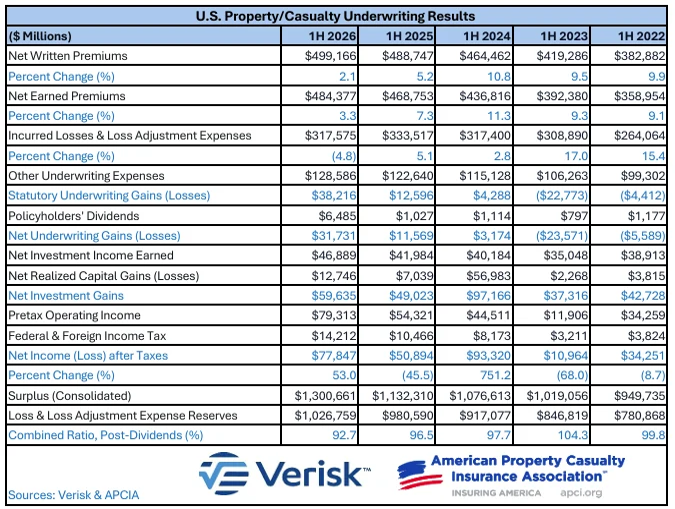
This week, Verisk and American Property Casualty Insurance Association (APCIA) reported that the property & casualty market recorded an estimated net underwriting gain of $31.7 billion in the first half of 2026, up from the $11.6 billion underwriting gain recorded through midyear 2025.
The industry’s combined ratio improved to 92.7, compared with 96.5 a year earlier, marking one of the strongest half-year underwriting performances in recent history. However, while industry underwriting gains improved during the first half of 2026, performance varied by line of business and geography.

What Are Your Goals for 2027?
Net written premium growth slowed to 2.1%, compared to 5.2% during the same period in 2025, while net earned premiums rose 3.3%, compared to 7.3% during the same period in 2025.
Policyholders’ surplus increased to $1.3 trillion, strengthening insurers’ ability to absorb future catastrophe losses and support long-term market stability, the report said. Half-year profitability was also supported by higher investment income. Net investment gains increased to $59.6 billion, compared with $49 billion during the same period in 2025, and net income after taxes increased 53% to $77.8 billion, compared with $50.9 billion in the first half of 2025.
Yet, regional catastrophe exposure remains elevated and continues to pose significant long-term risk, the report warned, even as the market benefits from a concerted effort to curtail legal system abuse.
“While overall industry profitability improved in the first half of 2026, largely due to a decline in insured natural-catastrophe losses compared to the first half of 2025 following the Los Angeles wildfires, insurers’ loss experience and profitability varied widely from state to state,” said Robert Gordon, senior vice president of policy, research and international at APCIA.
“In states that have enacted meaningful legal system abuse reforms, including Florida, Georgia and Louisiana, many policyholders have begun to experience reductions in auto and homeowners insurance rates that are expected to provide hundreds of millions of dollars in premium relief.”
For the first time in a decade, the 2025 Atlantic hurricane season ended without a single hurricane making landfall on the continental U.S. In the 2026 hurricane season, no hurricanes have made landfall so far, offering the market another boost, despite the looming threat of a major CAT event. Further, even with profitability improving, insurers continue to face mounting risks in several key casualty lines.
More Industry Trends



“While insured natural-catastrophe losses provided a temporary reprieve in the first half of 2026, bodily injury and commercial liability losses continued to worsen,” Gordon added. “Excess liability, umbrella liability, commercial auto, and other casualty lines experienced ongoing pressure from escalating claim severity, nuclear verdicts, and rising medical costs.”
“First-half results should not be mistaken as evidence that underlying risk has diminished,” added Saurabh Khemka, president of Verisk Underwriting Solutions. “Broader industry performance highlights the growing value of precision as property market conditions continue to soften. Increased market segmentation means insurers may benefit from a deeper understanding of exposures, claims behavior and portfolio performance to help support profitable growth as pricing becomes more competitive.”
Will Jones is IA editor-in-chief.
News Types
Insurance Markets
This month’s issue

The October issue is out now!