



As agencies lean more into artificial intelligence (AI), an important question arises: What part of the customer experience should remain human?
Americans are exhibiting concern about AI, consistent across generations, according to a poll from Quinnipiac University. They’re also pessimistic about its impact on creative thinking and forming relationships, according to Pew Research.
At commencement speeches across the country this spring, AI generated boos as the class of 2026 shared their feelings. However, Apple co-founder Steve Wozniak delivered a boo-free commencement speech on AI at Grand Valley State University.
“You all have AI—actual intelligence,” Wozniak said. “My entire life in the technical world, I’ve been following people who were trying to figure out how to make a brain. I was at a company where the engineers figured out how to make a brain.”
So how long? “Nine months,” Wozniak said, referring to the time it takes to build a human brain the old-fashioned way.
AI’s fading hype is just a normal part of any technology’s life cycle, according to the Gartner Hype Cycle, which outlines five phases every innovation undergoes. Technology launches with an innovation trigger. It snowballs into a peak of inflated expectations. That’s followed by the trough of disillusionment—where generative AI is currently, according to Gartner.
The trough of disillusionment is an important step, as innovations are tested and investments continue only if value can be proven. It’s then followed by the slope of enlightenment as use cases become more fully formed. Then, finally, comes the plateau of productivity with a clear payoff.
The insurance industry has been no stranger to the AI boom, and independent insurance agencies have no lack of options for AI tools. But as the consumer experience becomes saturated with chatbots, self-service portals and mass emails, it’s clear that no AI solution can replace what independent agents do best: Be human.
“We’re definitely in a world where technology is front and center, but the way I look at it, you can’t replace real human connection,” says Mel Evans, president and agency owner at Insurefit RM in Knoxville, Tennessee. “At the end of the day, being able to sit down, talk and actually hear someone is what builds trust.”
But that’s not to say AI doesn’t have its place. Insurefit RM uses AI and automation, but “it’s not a replacement for the human connection,” Evans says. “As AI continues to grow, authenticity is going to matter even more. The agencies that lean into the genuine human interactions are the ones that will be at the forefront.”
The biggest advantage in insurance is trust, says Andy Springer, chief client officer at RAIN Group. “Insight, reassurance, empathy and trust are where we are seeing insurance firms form unique and value-based differentiation, which sets them apart and they end up winning more business because of it,” he says.
“AI and automation can make agencies faster, but they do not automatically make them more trusted,” says Patrick Galvin, a speaker, author of “The Connector’s Way” and co-founder of The Relationship Building Academy™.
“People buy insurance because they want protection, reassurance, clarity and confidence,” he says. “That is especially true when they are confused by coverage, frustrated by rising premiums, buying a home, starting a business, adding a teenage driver or going through a claim.”
“Digital tools can answer questions quickly. They can send reminders, generate quotes and move paperwork along. Those things matter,” Galvin continues. “But they cannot look someone in the eye, hear the concern in a person’s voice or pick up on hesitation.”
For Joey O’Connor, vice president of commercial sales at Assured Partners, a Gallagher company, in Metairie, Louisiana, and national director for Louisiana on the Big “I” board of directors, AI frees him to have those important conversations.

“I use AI for technical expertise, but it’s a ‘trust but verify’ type of mode,” O’Connor says. “With my phone ringing and people walking in, it could take three days to go over 250 pages of a commercial policy.”
“You still have to review everything and make sure it’s correct, but it creates more time for you to take care of the non-digital touchpoints with clients, which a large segment still appreciates,” he adds.
Those low-tech interactions stand out more today “because they are becoming increasingly rare,” Springer says. “Something simple like a proactive phone call, an in-person review, a handwritten thank-you note can have a disproportionate impact because it signals genuine care.”
Care is key to combat the biggest threat every independent agency faces, according to Brittany Hodak, speaker and author of “Creating Superfans.”
That threat? “Apathy,” Hodak says, describing it as “people who don’t care enough to care that much one way or the other, who are just like, ‘tell me when the policy renews, tell me what it costs,’ and if a little bit of friction gets introduced because carrier availability has changed, they’re out.”
“Apathy is the enemy, and emotional touchpoints are the way that you can keep apathy at bay, because the customer understands that your story is connected to their story,” she says.
Here’s how independent insurance agents are prioritizing low-tech interactions for high-impact payoffs in marketing, sales and customer service.
Potential customers remember who showed up in the community long before they have a reason to call the office, says Dustin Cressman, partner and agent at Bixler Insurance Inc. in Berne, Indiana. Bixler Insurance won the 2025 Agency of the Year Award from Big I Indiana.
“We’ve heard business professionals in our town say that, when they think of the companies in Berne who faithfully support our community, Bixler Insurance is on the short list,” Cressman says.
It’s a reputation built by consistently showing up over decades. “It’s not just about sponsoring a local Little League team and getting the logo on the back of the shirt,” he says. “When people see you care and are investing in them and their kids, it builds trust.”
Bixler Insurance gives back to Berne and the greater Indiana community in a slew of creative ways. Matt Lehman, the agency’s president, is the majority floor leader in the Indiana House of Representatives; staff members volunteer in churches, school boards and sports leagues; and the agency is involved in the 4-H fair every summer, a crucial show of support in the rural agriculture-based area.
“Prospects have come into our office saying, ‘I no longer have an agent in my community, when I call their number I get a call center and I don’t like that.’”
This summer, Bixler Insurance will sponsor the Save a Life Tour, which will bring a driving simulator for high school students to learn about the dangers of distracted driving and driving under the influence.
“No one else has done an event like this in our area,” Cressman says. “We are doing it because we feel it is the right thing to do and will hopefully help students be safer drivers, whether those students are our clients or not. Indirectly, it builds our brand recognition and reputation as our current clients and potential prospects see we are investing in the safety of kids in our area.”
Insurefit RM’s office building was designed specifically to facilitate community connection, Evans says. “Our lobby is set up like a coffee shop, so clients can come in if they need to get some work done and get a free cup of coffee and snacks,” he says, mentioning that the refreshments are sourced from local coffee shops and bakeries. Clients also come in to use the agency’s large conference room for meetings.

The coffee shop lobby also houses a driving simulator that commercial auto clients can use to train drivers, Evans explains. It’s also popular for parents with teenage drivers. “That education is a great way to make human interaction happen,” he says. “We want to create an environment where people show up.”
“The whole idea is to make the office feel like a community space—welcoming, accommodating, easygoing and friendly,” Evans says.
In fact, Insurefit RM, which has a niche client base of breweries and distilleries, hosted a tasting event for a brewery client. “We filled up the building,” he says. “It allowed us to go above and beyond for a client and introduce them to new fans.”
Here are three ways to incorporate low-tech techniques into marketing:
1) Make yourself concrete. In an industry where the product is an abstract promise, “anything to create more visual references or experiential connections is going to make you easier to remember,” Hodak says. “Find what people care about—youth sports, a charitable organization. Being able to weave that into your relationships with clients can go a long way toward being seen as ‘my person’ rather than just someone they pay for services.”
2) Give value to your community. Insurefit RM supported a client’s business success. Bixler Insurance saw a way to fill an awareness gap. “Our logo’s getting out there, but we’re doing it as a community donation, not necessarily as directed targeted advertising,” Cressman explains.
Educational events are a great way for agents to create value, Springer says. “Insights create value and draw attention to your business, and agents are walking past insurance insights every day because it’s their world,” he says. “But to your clients, it’s not their world. They don’t know about any of those concerns or changes. They might love to know, but don’t have time to learn on their own.”
“If you create the event to share those insights—maybe a webinar, a 30-minute lunch-and-learn, a quick-fire podcast—you can help time-poor clients connect with that valuable information,” he says.
3) Build a robust referrals program. “When you have a client who refers someone else to you, it is imperative that within a short window of time you acknowledge that referral,” Hodak says. “It increases the likelihood they’re going to do it again.”
“A phone call, a note or a small, thoughtful gesture can turn a one-time referral into a lasting referral relationship,” Galvin agrees.
The personal aspect of a referral reverses the tendency to review insurance like a commodity. “When people get a referral from a friend, price jumps from the first thing on their list to the seventh or eighth thing,” Hodak says. “And non-digital interactions are much more likely to create the emotional connection to make you easier to refer.”
AI often promises speed and efficiency. But in sales, acceleration can be too much of a good thing. “Low-tech interaction gives agents a chance to slow the conversation down and build real trust,” Galvin says.
“We’re picking up the phone, we’re sitting down with clients face to face,” Evans says. Insurefit RM’s coffee shop is a natural venue for those conversations. “When it feels more like a conversation than a transaction, that tends to lead to more success,” he says.
In a conversation, an agent can “uncover what the prospect values, what worries them and what they may not be saying out loud,” Galvin says, because “a lot of prospects do not understand insurance as well as agents think they do.”
O’Connor uses lead-generating platforms, but “we will still make cold calls,” he says. “People are busy, so you do your research ahead of time and find a pain point to bring up with them.”
That personalized preparation is key, Springer says, with the most successful agents the ones who can demonstrate a deep understanding of the prospect’s pain points. “How do you tailor your messaging and demonstrate a deeper understanding of your client’s business?” Springer says. “If the client feels like it’s generalized information or a general value offering, they don’t feel very special.”
When O’Connor sees an applicable article, he’ll pass it along to a client and then follow up with a phone call if it’s a timely issue. “I’m always being asked about what’s happening in specific industries, so being able to capture trends and what’s going on is important.”
Passing along those relevant pieces of information with an explanation of exactly how it applies is an excellent way to add value, Springer agrees. “The client walks away from the touchpoint thinking, ‘Wow, I learned something new, I’m better educated, I feel like that person has my best interest in mind,’” he says. “It’s a low-tech thing you can change in your interaction preparation.”
Galvin recommends agents lose the typical “What coverage are you looking for?” prompt and get better at asking discovery questions:
A fruitful sales conversation is an art form. “Don’t just turn up and talk about features, benefits, policy details. Boring,” Springer says. “To get good consultative conversations, train your team and have them practice, practice, practice.”
Category 4 hurricane Ida caused catastrophic damage when it made landfall in southeastern Louisiana in August 2021. One of O’Connor’s clients is a local artist whose warehouse was hit by a storm-related tornado. “It pretty much devastated his operations,” O’Connor recalls. “I drove out there to pat him on the back and tell him, ‘We’re here for you every step of the way, we’re going to see you through this.’”
For the next couple of months, the artist called O’Connor every week to thank him for showing up.
“We were able to get him back on his feet, and he’s still in business today,” O’Connor says. “There is a human element to our business that’s very important, and we shouldn’t just shrug it off and say AI can do it more efficiently—because I’m not sure it can, in situations like that.”
“Insurance clients remember moments of uncertainty, claims, disruptions, difficult decisions and human responsiveness as much more meaningful than automation,” Springer agrees.
Customer service is a huge opportunity to let the human element shine, and not just in moments of crisis. In fact, it’s the neutral interactions that can bring significant gains, Hodak says.
“There are only three types of experiences: net negative, net neutral and net positive,” she explains. “So many interactions are neutral, and that’s dangerous because it leads to apathy. But when you elevate the neutral touchpoints to positive, that’s where you will find ways to truly delight people.”
Portal Insurance in Mobile, Alabama, has a gifting program called Portal Pure Moments. Pure stands for personalized, unexpected, real and extraordinary, explains Bradley Flowers, agency founder. “Every gift has to hit all four,” he says. “If it doesn’t, we don’t send it.”
Every week, every team member has to bring one personal detail about a client. “What they’re into, what they just told you about their kid, the band they mentioned on the phone,” Flowers says. “We log it, and that’s what drives the gift.”
Portal Insurance used to spend $30 to $50 on a welcome gift, but over four years of doing so “had zero customers tell us thank you,” Flowers says. “Now we’re at about $15 a gift, and the response is night and day—every single client has told us thank you, some even taking to social media to shout us out. This will have a lasting effect on retention and customer relationships.”
“No more triggered gift card sends, no more premium-threshold gifts where the big accounts get a gift and the small ones don’t,” he says. “That’s not the point. The point is ‘we thought about you.’”
Yes, it takes more time and thought. But “all the AI tooling we’ve built, the intake stuff, the renewal dashboards, the Slack agents, none of that matters if we don’t redeploy the time it saves,” Flowers says. “Automate the boring, own the relationship.”
Here are three ways agents can elevate their customer service experience:
1) Be proactive. “One major differentiator is proactive outreach before the client has to ask,” Springer says. “Checking in before renewals, reaching out after major weather events, business events, cyber events or when market conditions shift—that is customer service. It demonstrates care and expertise.”
2) Train staff to solve problems. “Staff members often feel pressure to solve the issue quickly,” Galvin says. “Efficiency matters, but clients also need to feel understood. Start by training people to listen better.”
Training staff on phone confidence can also result in a better experience. “Many younger professionals are comfortable with email and text but less comfortable with live conversations,” Galvin says. “Role play common situations: premium increases, billing confusion, claim frustration, coverage questions and unhappy clients. Give people language they can use, but do not force them to sound scripted.”
3) Remove service complexity. How easy is it for a client to get answers? When they call your agency, do they get greeted by a robot voice? Does the website chatbot lead them in loops?
“A lot of companies create layers and layers of complexity without realizing it,” Springer says. “Technology can get out of whack real quick. We build barriers to connection to our customer—we don’t do it intentionally, but it forms over time.”
O’Connor has given all his clients his cell phone number, and he has theirs. And Bixler Insurance leaves it up to the client to decide how they want to communicate, whether by cell phone, email or walking into one of their seven brick-and-mortar offices.
The personal access does take time. Internal AI and automation helps alleviate staff burden, but “we don’t want to have AI answering the phone, we don’t want our clients to be interacting with it,” Cressman says. “That’s the crossroads agencies are at today: How do we balance utilizing AI to efficiently operate as an agency but still maintain that personal touch.”
“We’ve attracted new clients because of it,” Cressman says. “Prospects have come into our office saying, ‘I no longer have an agent in my community, when I call their number I get a call center and I don’t like that.’”
The return on investment? Crystal clear. “We’ve gained new personal lines accounts, commercial accounts, health accounts because they want an agent they know,” he says. “If we became a fully AI-automated agency, we could cut overhead costs, we wouldn’t have to have seven offices, but we still see value in being present. It’s working.”
AnneMarie McPherson Spears is IA news editor.
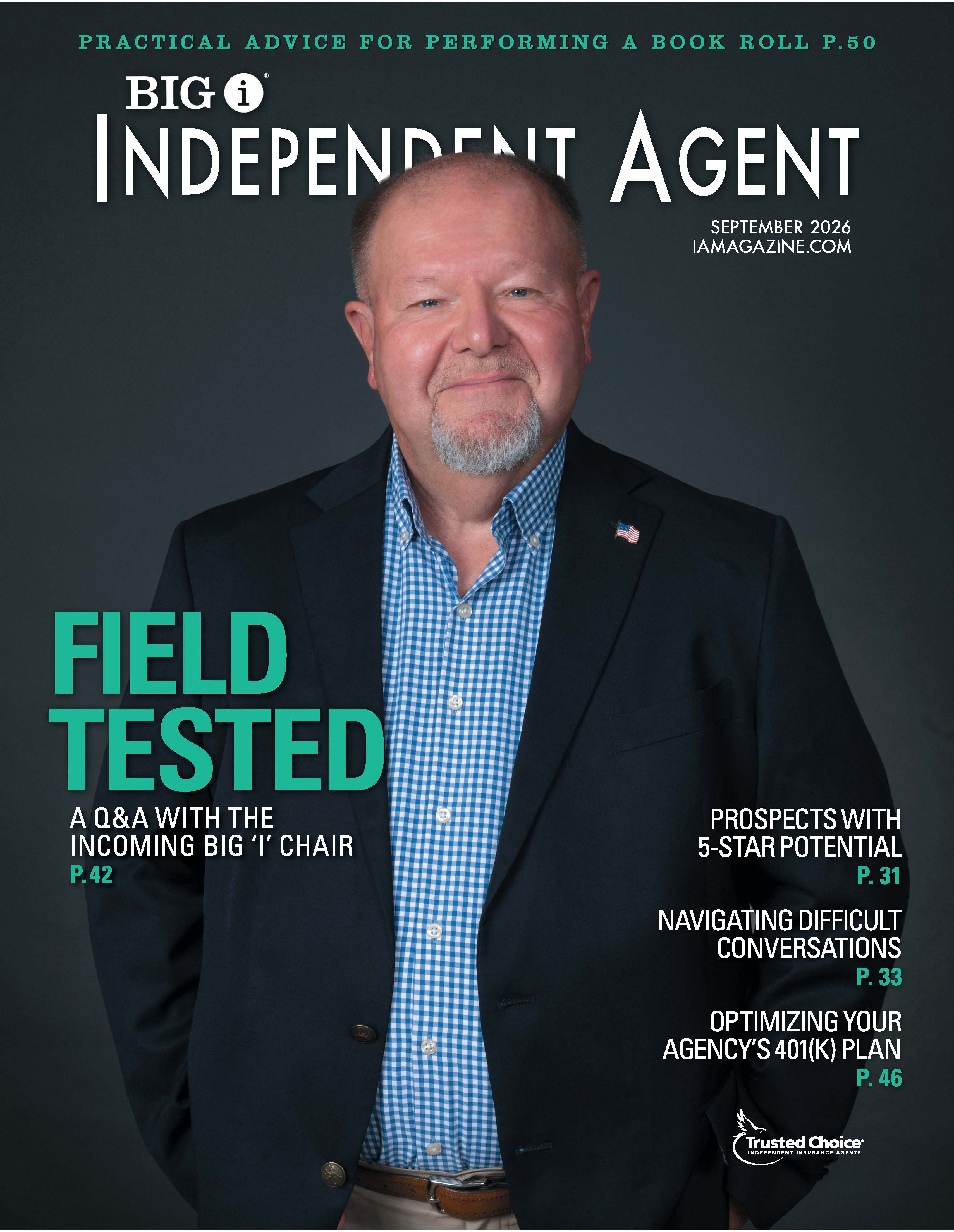
The September issue is out now!