Be Seen as AI Changes the Way Consumers Search for Insurance

Walk-in prospects are a rarity at any of the four locations of River Valley Insurance Group, headquartered in Madison, Alabama. “We might get one a month,” says Jason Wallace, one of the agency owners. “Well, last week we got two.”
One said he had found the agency through Google. The other? “He said, ‘AI told me to come see you guys,’” Wallace recounts.
Consumers are increasingly turning to artificial intelligence (AI) to search for answers to insurance questions and even to find agencies. About 3 in 10 auto and home insurance customers use AI to research products and coverage, service accounts, prepare for a claim or shop for a policy, according to the J.D. Power “U.S. AI Insurance Experience Study.”
It’s not limited to personal lines, either. More than 1 in 3 (36%) of entrepreneurs have used an AI chatbot or search tool to explore business insurance options, according to a survey by ERGO NEXT.
Independent agencies are seeing the shift firsthand. At Mason-McBride Insurance in Troy, Michigan, “roughly 1 in 5 new prospects can be traced to an AI tool playing some role in their research before contacting our agency,” says Casey Rotary, Mason-McBride’s director of marketing.
AI is now baked into the search engine experience, so if a prospect uses Google to ask a question, they’ll be first served by an AI Overview that provides the answer—and they don’t even have to visit a website. That behavior is called “zero-click” search, says Manny Barbosa, Agent for the Future advisor, during a session of the Agent for the Future AI Bootcamp for Independent Agents.
As a result, consumer search behavior is shifting. “AI is making insurance research more conversational and more specific to a person’s actual situation,” Rotary says. “A consumer does not have to know that they need something called umbrella insurance. They can say, ‘We bought a second home, our teenager is driving or our assets have grown. Do we have enough protection?’ and AI can help them understand what questions they should be asking.”
More From the November Issue



For an independent agency to remain visible, she finds that the shift “is no longer just about appearing when someone searches for an insurance product or ‘agent near me.’ We also want to be found when someone describes a situation that matches the expertise we have.”
Luckily, communicating expertise as a trusted advisor has always been the independent agency channel’s selling point. However, how to communicate that value is changing. “The challenge is more about making sure that expertise is available online and in a way that both humans and AI can easily find and understand,” says Amy Barley, web content strategist at Maryland Health Connection and vice president of programming at the American Marketing Association’s Baltimore chapter.
Currently, 24% of independent insurance agencies cite search engine optimization (SEO) in their top three marketing strategies, while 13% cite AI searches, according to the 2026 Agency Universe Study.
Building visibility in search is a long game—and agencies that wait could find their competitors’ digital authority has pulled years ahead. “We want to be at the beginning of it all and try to learn, instead of playing catch-up,” Wallace says. “We’re investing heavily in it.”
Information Is Not Advice
Because AI provides consumers with direct answers to their search queries, prospects are often further down the purchasing path by the time they contact an agency.
“When AI is assisting leads, our data points to people coming to us when they’re closer to making a decision,” Rotary says. “They’ve already gotten through the general information search and are lower in the funnel.”
This presents both opportunity and danger. “The consumer may be showing up well-informed, but they also may be ill-informed,” says Bob Whitis, chief operating officer at BrightFire. “It’s even more important than ever for agents to dig in and do a thorough consultation, especially with commercial policies.”
It all boils down to the value of an independent insurance agent. “I think AI can help people arrive at the conversation better informed, but there is still a difference between information and advice,” Rotary says. “An AI tool may explain what umbrella insurance is. But an advisor can look at the client’s actual situation, ask follow-up questions and identify issues the client may not have realized were relevant.”
Consumers still appreciate that value. A human insurance agent remains important to the vast majority (87%) of consumers, according to a recent Big “I” study. In particular, 9 in 10 consumers want a dedicated, human agent when making a decision about insurance.
The Fundamentals of AI Search
Search engine optimization (SEO) is a well-established marketing discipline for ranking in search results. But as the list of links makes way for AI-generated summary answers, two new acronyms have emerged: answer engine optimization (AEO) and generative engine optimization (GEO).
AEO aims to make an agency’s content part of a direct answer, including a Google AI Overview or voice-assistant response. Generative engine optimization (GEO) aims to make the agency a source that AI programs like ChatGPT cite, summarize or recommend.

Use AI Without Losing the Human Touch
To be visible to today’s consumers, an agency’s search visibility strategy should include both AEO and GEO—although SEO has not gone the way of the dodo.
“I do not see AI search as a replacement for SEO,” Rotary says. “Most of the fundamentals are the same: have a strong website, publish useful information, clearly explain who you serve and demonstrate real expertise.”
Agencies that have kept up to speed with SEO should be encouraged. “One of the most exciting things about both AEO and GEO is that they don’t really require marketers to start from scratch,” Barley says. “It really only requires you to do some fine-tuning on your current SEO strategy.”
While there are some differences between AEO and GEO, AI search in general rewards content that meets four principles, according to Barbosa:
1) Fresh. Similar to classic search engines, AI search prioritizes sources that publish regularly and are updated frequently, Barbosa explained. “Especially important in the AI world is making sure that last-updated signals are present on your content,” he said. “That’s usually in the form of a date.”
2) Authoritative. AI search places more emphasis on an identifiable author to demonstrate trustworthiness. “We are paying more attention to the expertise of individual people within the agency,” Rotary says. “AI search may make an individual agent’s experience and expertise more visible, not just the agency brand.”
3) Structured. Just as website and content structure is important in SEO, it’s also important to help AI programs navigate your agency’s online presence. Webpages should be organized with headers and bullet points that provide “anchor points” to help “not only humans but also AI to sort through structurally,” Barbosa said.
The bones of your website should be structured, Whitis says, pointing to schema.org—founded by Google, Microsoft, Yahoo and Yandex—as the gold standard for structured data standards. “There’s a specific schema for an insurance agency as a subtype of a local business,” he says.
4) Clear. When your agency’s website directly and clearly answers the questions people are asking online, “you’re going to increase the chance that your agency’s content will surface when Google provides an AI-generated answer,” Barley says.
8 Steps to Make Your Agency Visible in AI Search
AI values fresh, authoritative, structured and clear sources. By applying those four principles, your agency can stand out in the era of AI search. But what do they look like in practice?
Here are eight ways to improve your AI search visibility:
1) Make sure your business information is consistent. Your agency’s information should be identical on every single digital asset. “I see people change the name of their business, forget about updating addresses when they move, things like that,” Barbosa said. “That can cause a little bit of a headache for you in the online world without you realizing it.”
This includes the exact name of your agency. “Use your agency’s full name. Leverage your brand identity,” Barley says. “I would be highly against using any abbreviations, unless the abbreviation is your actual business name.”
2) Complete your Google Business Profile. Each physical location should have a verified profile with current hours, contact information, products and services, Whitis says. One area agencies commonly miss is setting up categories. “They don’t have every market listed, but look through and make sure anything that’s relevant to you is selected,” Whitis says.
Big “I” members should also make sure their TrustedChoice.com profile is complete and current, including agency name, address, phone number, website, lines of business and other key details. An updated profile can help consumers and AI search tools find accurate information about the agency when they are looking for an independent insurance agent.

The Evolving Market Toolkit
3) Clarify your client profile and risk appetite on your website. “We’re being clear about what we are targeting,” Rotary says. “Instead of saying we’re a ‘one-stop shop’ and we offer everything to everybody, we list specifically the specialties we offer.”
Mason-McBride’s website includes a list of their niches with a clear, succinct description of each one. “There are a lot of financial service companies that don’t have all their services listed, or there might be things on your website you don’t even offer anymore,” she says.
4) Answer commonly asked questions. One of the most straightforward ways to help your agency appear in AI answers is to provide those answers on your website. “AI is searching our content for short, quick answers in written content,” Wallace says. “If that content isn’t on your website, AI’s not going to pull you.”
“Instead of thinking in terms of what keywords should we rank for, agencies should also start thinking, ‘What questions are our customers asking and are we providing the best answers for them?’” Barley says.
Whatever the format, content should provide the “direct answer first, explanation after,” Barbosa said. While insurance is often complex and nuanced, “get as close as you can to giving a clear initial response, and then provide context and details below that,” he said.
5) Boost freshness signals. “Freshness really matters for being cited and recommended in AI,” Rotary says. “Setting and forgetting your service pages for five years is not going to be a signal that gets you ranked.”
“Always include the most recently updated date,” Barley says. “If you have older content, such as blog posts that are still relevant, take the time to go in and make sure they’re updated.”
Activity has been an important part of River Valley’s AI search strategy, Wallace says, and it doesn’t have to eat up large chunks of staff hours. “It could be something as simple as doing a short 30-second video on a topic once a week, adding captioning and posting on your website, social media and YouTube,” Wallace says. “AI sees that and it signals that you’re an expert.”
6) Amplify individual authorship. Capitalizing on AI search’s emphasis on individual authority, “we are amplifying the specialties of our staff on their individual profiles,” Rotary says. “We add credentials and designations, and for key staff we have dedicated pages that outline their expertise so it’s clear to AI search.”
“We have several people on our team who are creating a brand for themselves under the River Valley name and logo—not outside of it, but under it,” Wallace says. “This creates a huge digital footprint, and the bigger the footprint, the more Claude, Copilot and ChatGPT are going to see it and pull from it.”
Content such as blog posts should also have a clearly identified author, Barbosa said. “That’s something that’s often missing with blogs today that I suspect might start to change,” he said.
7) Build and showcase reviews. Review volume helps, but recency and responsiveness also signal that an agency is active and engaged, Whitis says. “The agencies that are asking for Google reviews as part of their daily business have built a strong reputation and are reaping the rewards,” he says.
Reviews are a valuable indicator of authority, but sometimes AI needs help finding them. Whitis points out that, at least currently, Google Gemini is the only AI tool that can see reviews in Google. Any other programs must find those reviews elsewhere. To ensure ChatGPT, Claude, Grok and other programs can find your reviews, “you should actually display your Google reviews on your website,” he says. “It’s a resource for AI, but it’s also social proof to drive conversions.”
8) Earn quality citations and backlinks. Those external references help AI tools verify your business’s legitimacy and establish authority. Citations include “local listings on directory websites,” Whitis says. Those listings will have your agency’s name, address and phone number—referred to as NAP—and even hopefully a link back to your website.
Backlinks are instances in which other websites link back to your website. Crucial in traditional SEO, they continue to weigh heavily in AEO and GEO.
“The approach here is quality over quantity,” Whitis says. A great source of high-quality industry backlinks is carrier websites. “If your appointed carriers have an agent finder on their website, make sure the information is up to date,” he says.
Barley recommends including relevant and detailed content on your website that provides deep dives into specific topics. “Create original, data-driven content—research reports, case studies, other unique insights—that others will naturally want to cite,” she says. “Those assets are backlink magnets.”
Both AEO and GEO pull from signals of freshness, authority, clarity and structure, and both build off tried-and-true SEO principles. However, AEO places a greater emphasis on onsite factors, many of which overlap with SEO, Whitis says.
“You’re going to have slightly more control over AEO because the most impactful factors are very similar to SEO,” he says. “GEO is slightly more focused on citations, and that will take a bit longer because it relies on factors outside of your website. But in general, the same practices are impactful for both.”
Capitalize On Your Visibility
For agencies, the point of search visibility isn’t just to be found—it’s to sell insurance. “If someone discovers your agency after researching an insurance question, you want to make the next step incredibly easy and seamless,” Barley says.
Since AI search will likely lead a consumer to either your Google Business Profile or your website, Whitis recommends adding clear calls to action on both, whether to call or fill out a form. And however the prospect reaches out, agents should follow up quickly and set expectations for next steps.
But how do you know if following these principles is worth it? Measuring AI leads is a key determiner of ongoing success, but it’s also “the biggest challenge,” Rotary says, because “AI can influence someone’s decision to call us without ever sending them to our website.” And those leads don’t leave evidence in the metrics.
She recalls a recent instance of a homeowner who asked Gemini who the best insurance agent was in his area. Gemini provided the name of a Mason-McBride agent, so the homeowner called the agency and asked for her specifically. The agent ultimately helped him and his wife move their home and auto coverage to Mason-McBride.
“He never visited our website, so if we were only looking at Google Analytics, we would have missed the entire customer journey,” Rotary says. One of Mason-McBride’s crucial measurement tools is “simply asking prospects, ‘How did you find us?’” Rotary adds. “We document those conversations and look for patterns.”
River Valley has invested in a third-party vendor to assist with its AEO and GEO, since marketing often falls on the shoulders of the ever-busy agency owners. “We’re measuring referrals and leads,” Wallace says. “Our goal is to get a 10-times return on any marketing or lead investment. We’re not getting that yet from AI search, but if it continues the upward trajectory, we can definitely see that coming in the future.”
Agencies can monitor some performance in Google Search Console and Google Analytics, Whitis says. Google Search Console is currently the only tool that can reliably indicate how many times your agency has been mentioned by AI—and even then, it only provides data for Google Gemini.
Google Analytics does display website visits from AI assistants. However, the default data retention timeline is two months and the maximum is 14 months. “That’s not a very long time when we’re talking about long-term strategies like SEO, AEO and GEO,” Whitis says. He recommends that agency owners invest in a reporting system that integrates with Google Analytics to store the historical data, or utilize programs like Google Cloud’s BigQuery for long-term storage and insights.
The work is cumulative. And while it may seem daunting, Wallace encourages agencies to give it a try. “Everything we’re doing is not just for the here and now, it’s for the future,” he says. “Maybe that person doesn’t spend a dollar on a policy today, but six months down the road, they will remember, ‘Oh, they’re the ones who educated me and answered my question.’”
An Opening for Independent Agencies
AI search may offer independent agencies a new route around the advantages that large brands have, Rotary says, pointing to a recent Conductor study that examined 3.6 million insurance-brand citations and found that no single brand dominated AI citation visibility. In fact, half of insurance citations in Google AI Overviews came from pages outside the traditional top 10 search results.
While big budgets and long-established history still bring advantages, “if AI becomes better at matching a very specific situation with relevant expertise, an independent agency that understands a particular risk or type of client may have a better chance of being discovered,” Rotary says. “That could be a meaningful opportunity for specialized independent agencies.”
Rotary has ensured Mason-McBride’s website is updated with niches and specialties, with individual authority to match, and it’s paying off. The agency’s AI-assisted leads are often “businesses with complicated risks that are having a hard time getting coverage,” she says.
“We’re in Michigan, but we’re getting AI-assisted leads in California, Texas, Florida, that are complicated and looking for someone with a specialty,” she says. “It’s an open playing field right now and you do not have to be a household name to get cited in an AI recommendation.”
August was Mason-McBride’s highest month for inbound lead volume, up more than 60% from August last year. It built on the momentum of the previous three months, each of which saw a 50% year-over-year increase.
“We haven’t added budget, and we don’t run paid search or paid campaigns,” she says.
The only new marketing initiative? AI search.
“I wouldn’t say AI is the only driver—there are too many variables—but when I look at the numbers alongside the shift we’ve made in our organic strategy, it makes me optimistic about where AI search is headed,” Rotary says.
AnneMarie McPherson Spears is IA news editor.
Agency Management Solutions
Big I Programs
This month’s issue
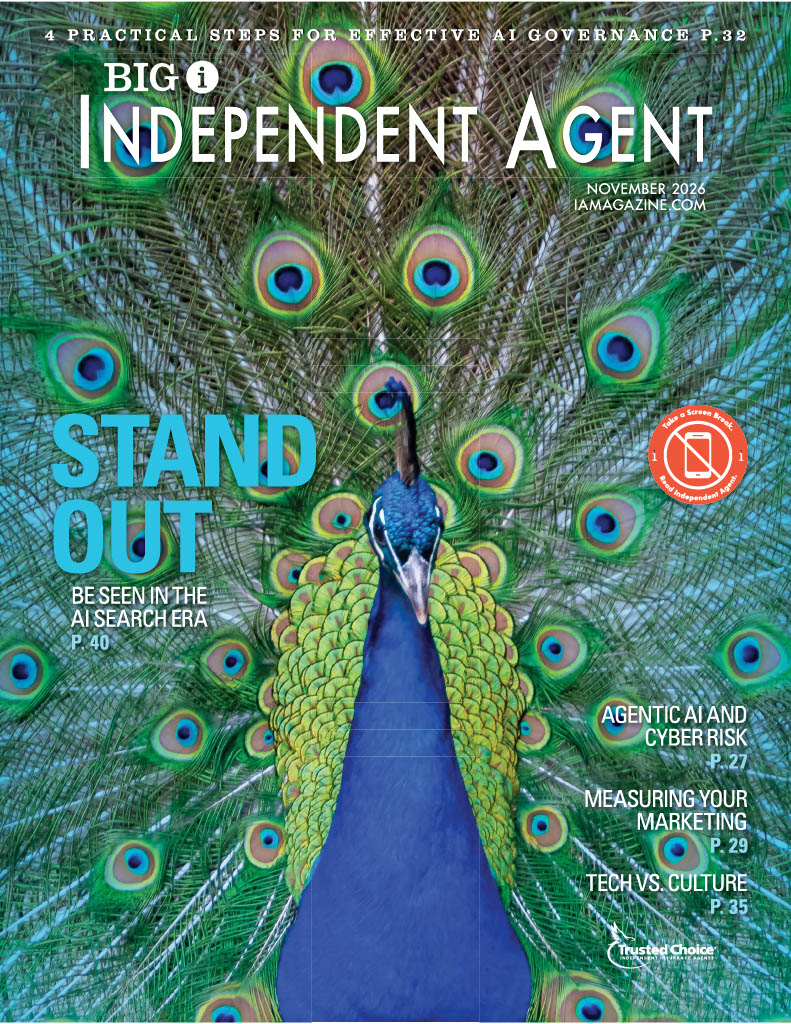
The November issue is out now!