Keeping Up with the Joneses
By: Mike Miley
Is your agency growing its revenue? Do you produce an adequate net margin? Most important—do you know the answers to both of these questions?
In the quest to keep your agency running every day in the midst of a soft market and a difficult economy, it’s more important than ever to take a step back. Every day that you’re not growing revenues and producing an adequate net margin, the value of your agency is eroding. Do you know where your agency stands in comparison to your peers? Luckily, the Big “I” has a suite of tools to help you evaluate your agency’s performance while learning from the best agencies in the business: Best Practices.
My agency, The Gibson Agency in Indiana, has been involved in Best Practices since 1994, a year after the program launched. Participating agencies say they do it because they find it is an excellent way to manage their agency. Once a year, it forces them to really look at their operations and determine whether or not they are collecting all the information they need to evaluate their performance. How can the Best Practices program help you?
Analyze industry growth against your results. You’re down by 5% in commercial lines, but is your competitor up by 5%? The Best Practices study can tell you. It looks at agency growth by line of business in revenue categories, so you can easily make an apples-to-apples comparison with your peers. This year, for example, the study found that personal lines was the area with the most organic growth across revenue categories. If your agency hasn’t been spending time and effort on your personal lines book, it might be time to reconsider. It’s this type of market insight that can help you better run your agency.
Take a closer look at producer performance. Is your new producer performing up to par? Are your veteran producers coasting? The Best Practices study data for growth by producer will give you a good benchmark for how much new business producers at peer agencies generate. And it can help you set realistic growth and production goals for your own agency.
Get a productivity snapshot. The Best Practices study gives an overview of the support services typically present at each revenue category. For example, if the study indicates that agencies in your revenue category have three producers and eight CSRs and your agency has 12 CSRs, it might be time to take a closer look at your agency operations.
Become a better manager. Our agency uses the process of submitting Best Practices data to look at new production and maintain our producer pipeline. We look at the revenue per account and where the business is concentrated within the agency and then use that information to best allocate resources. The same is true on the expense side. If our agency’s expenses for a certain line item—technology or marketing, for example—are out of line with our peers, we want to know why. Some agencies find that their expenses are out of line because of sloppy accounting and allocations; other agencies find that the discrepancies can be a jumping off point for a management discussion. For example, if your agency’s postage expense is higher than your peers, it might mean you are communicating more with customers via regular mail—is that good or bad? Again, it starts the conversation. If you aren’t comparing yourself to your peers, it would be easy to look at an income statement and say “We’re doing better than we did last year,” without realizing there is much more opportunity for improvement.
If you’ve never participated in the Best Practices program, receiving the initial packet of information to fill out might be a bit overwhelming. In fact, most agencies say that if they didn’t take part in the study, they probably wouldn’t put themselves through the pain and agony of such a rigorous data collection. Instead, like so many agencies, they would say “We’ll get to it later”—and never do it.
But for those who apply and are selected for Best Practices agency status, it is a valuable marketing tool. Agency employees are proud to say they are part of an elite class of agencies. And the designation can help recruit new clients while improving current client relationships. It is so important to our agency that we make sure all of our clients know about it.
But you don’t have to be a Best Practices agency to benefit from the in-depth benchmarking research it provides. Do you know where you stand? Go to www.independentagent.com and click on “education” to find out.
—Mike Miley, Big “I” chairman
In the quest to keep your agency running every day in the midst of a soft market and a difficult economy, it’s more important than ever to take a step back. Every day that you’re not growing revenues and producing an adequate net margin, the value of your agency is eroding. Do you know where your agency stands in comparison to your peers? Luckily, the Big “I” has a suite of tools to help you evaluate your agency’s performance while learning from the best agencies in the business: Best Practices.
My agency, The Gibson Agency in Indiana, has been involved in Best Practices since 1994, a year after the program launched. Participating agencies say they do it because they find it is an excellent way to manage their agency. Once a year, it forces them to really look at their operations and determine whether or not they are collecting all the information they need to evaluate their performance. How can the Best Practices program help you?
Analyze industry growth against your results. You’re down by 5% in commercial lines, but is your competitor up by 5%? The Best Practices study can tell you. It looks at agency growth by line of business in revenue categories, so you can easily make an apples-to-apples comparison with your peers. This year, for example, the study found that personal lines was the area with the most organic growth across revenue categories. If your agency hasn’t been spending time and effort on your personal lines book, it might be time to reconsider. It’s this type of market insight that can help you better run your agency.
Take a closer look at producer performance. Is your new producer performing up to par? Are your veteran producers coasting? The Best Practices study data for growth by producer will give you a good benchmark for how much new business producers at peer agencies generate. And it can help you set realistic growth and production goals for your own agency.
Get a productivity snapshot. The Best Practices study gives an overview of the support services typically present at each revenue category. For example, if the study indicates that agencies in your revenue category have three producers and eight CSRs and your agency has 12 CSRs, it might be time to take a closer look at your agency operations.
Become a better manager. Our agency uses the process of submitting Best Practices data to look at new production and maintain our producer pipeline. We look at the revenue per account and where the business is concentrated within the agency and then use that information to best allocate resources. The same is true on the expense side. If our agency’s expenses for a certain line item—technology or marketing, for example—are out of line with our peers, we want to know why. Some agencies find that their expenses are out of line because of sloppy accounting and allocations; other agencies find that the discrepancies can be a jumping off point for a management discussion. For example, if your agency’s postage expense is higher than your peers, it might mean you are communicating more with customers via regular mail—is that good or bad? Again, it starts the conversation. If you aren’t comparing yourself to your peers, it would be easy to look at an income statement and say “We’re doing better than we did last year,” without realizing there is much more opportunity for improvement.
If you’ve never participated in the Best Practices program, receiving the initial packet of information to fill out might be a bit overwhelming. In fact, most agencies say that if they didn’t take part in the study, they probably wouldn’t put themselves through the pain and agony of such a rigorous data collection. Instead, like so many agencies, they would say “We’ll get to it later”—and never do it.
But for those who apply and are selected for Best Practices agency status, it is a valuable marketing tool. Agency employees are proud to say they are part of an elite class of agencies. And the designation can help recruit new clients while improving current client relationships. It is so important to our agency that we make sure all of our clients know about it.
But you don’t have to be a Best Practices agency to benefit from the in-depth benchmarking research it provides. Do you know where you stand? Go to www.independentagent.com and click on “education” to find out.
—Mike Miley, Big “I” chairman
This month’s issue
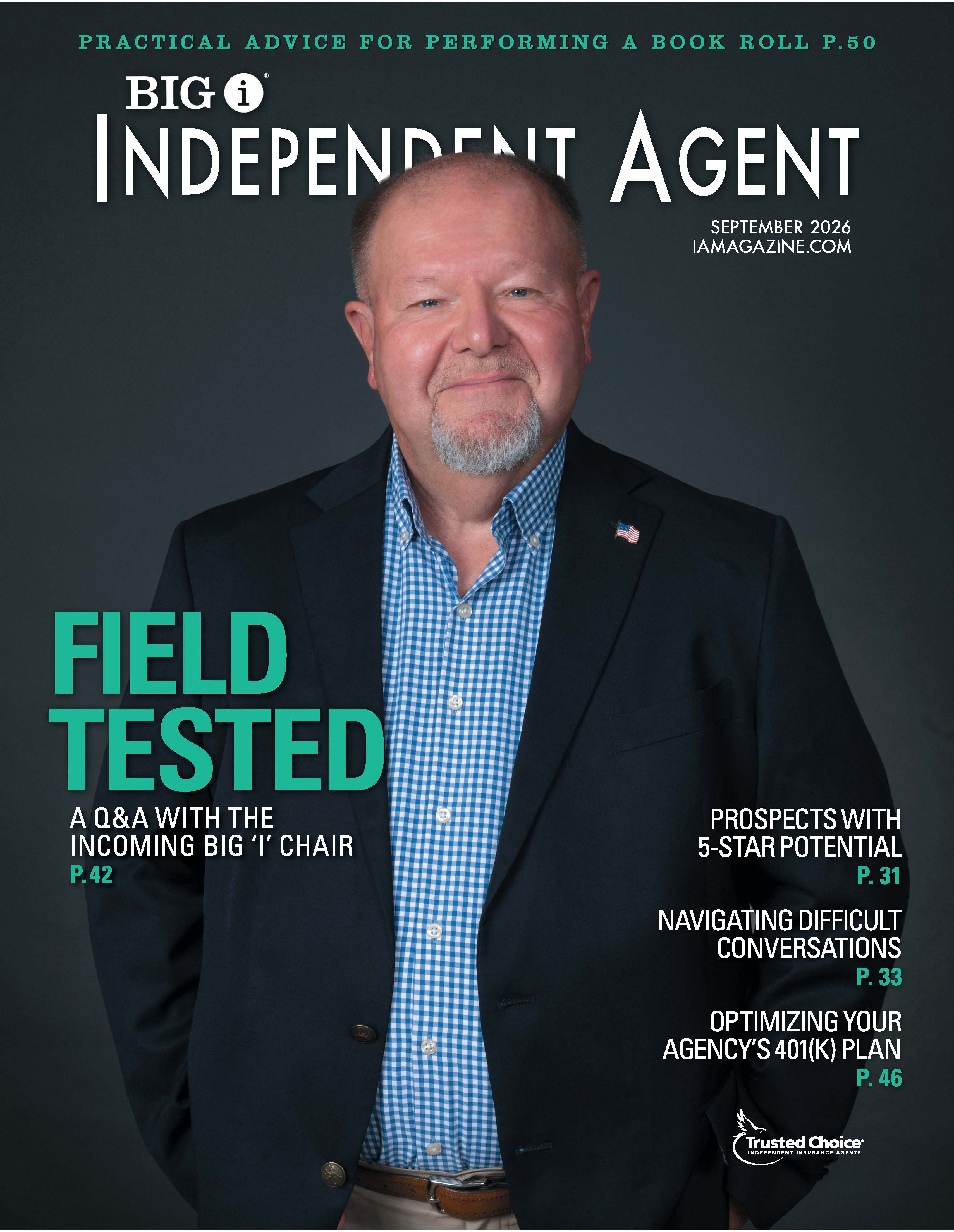
The September issue is out now!