Small Town to the Big Time – and Back
By: Katie Butler
Today, the average 26-year-old might be working in a dead-end first job, attending graduate school, or in this economy, even sleeping on Mom and Dad’s couch.
By 26, new Big “I” Chairman Mike Miley had already bought his own insurance agency.
Miley plays down the entrepreneurial spirit that made him take the leap at such an early age. “It’s a lot easier to do when you have nothing,” he says. “What do you have to lose?”
Miley’s insurance career had a start familiar to many people in the industry—a family connection. After attending Arizona State, he came back to Plymouth, Ind., a town of 10,000 where he was raised. He married wife Cindy and started life in the insurance business in 1973 with his father-in-law, a teacher who was also a part-time life insurance agent. “It didn’t take me long to realize that p-c was more my speed,” Miley says. “I think I liked the idea of developing programs for people and solving problems. There seemed to be more variety [in p-c] than on the life insurance side.”
So Miley bought a small agency with a land contract at age 26, making monthly payments to the owners. By 1983, though, he was seeking a bigger playing field. “We merged with the Gibson Agency—I saw Gibson Insurance Group has offices in that there was a lot more opportunity in a larger shop,” he says.
Miley joined the agency in the role of commercial producer, and although he is still a generalist, he works with a lot of public entity clients, especially schools.
Now approaching 40 years in the industry ,Miley says what has kept him engaged and interested in his work is the daily problem solving. “I like it when clients take me in as a trusted advisor—when they are calling me up asking for advice,” he says. “Then you know you have arrived as an insurance professional and are not just another salesperson.”
Many Demographics, One Agency
Population: 10,000…populations: 125,000…population 1 million. The Gibson Insurance Group has offices in Plymouth, Ind.; South Bend, Ind. And Indianapolis, creating a unique blend in one agency of serving the full spectrum of communities and customers, from small town to large metro area. Although the original agency location was in Plymouth the firm eventually branched out to larger communities in order to have more business opportunities. Currently, the firm has 90 employees across the three offices.
Miley is based in the Plymouth location, but he works with clients in all three offices. He believes his experience with diverse client demographics will provide a great background for relating to all types of Big “I” members. “We cover all the bases of different client types,” he says. “I can relate to small member agents because I’ve been one and I live in a small town. And I can relate to larger metro-area agents too.”
Regardless of the size of the agency, Miley notes that all independent agents are facing similar challenges in running their business today. He notes that competition among agencies has gotten more intense, primarily because agents are more professional and doing more. “We’re being pushed to do more of the services—i.e. loss control,” he says. “These things are being pushed down to the agents and squeezing our revenue. We’ve had to get more creative, for example in using fee for service items, but it’s also an opportunity.” And the ultimate perennial challenge: finding good people, Miley says.
An Agency Tradition of Service
For Miley, the path to service at the Big “I” was paved by mentors in his agency. Miley’s relationship with the Big “I” began in 1978, when he was a member of the Marshall-Fulton-Starke Counties Independent Insurance Agents Association; he later went on to serve as its president. But a push from within his own agency’s leadership got Miley involved at the state level on the Indiana Young Agents Committee. “[Agency owner] Dave Gibson got me involved in Young Agents,” Miley says. “His father was president of the state Big ‘I’, and Dave was going to be state president. There is a long history in the agency of an association with the Big ‘I’.”
During his affiliation with the Independent Insurance Agents of Indiana (IIAI), Miley served on a number of committees, including state government affairs committee, first chairman of the for-profit entity and chairman of the Big “I” PAC. In 1992, he was elected to the executive committee of IIAI and served as president in 1995. He was then elected as Indiana’s representative to the Big “I” national board of directors in 1997. Among his accolades at the state level: Chairman of the Year award for his work on the new products and services committee; Indiana Agent of the Year Award (1989 and 2006); Honorary Commissioner of Insurance (1990) and the first recipient of the Harry P. Cooper Public Image Award (1991).
On the national association level, Miley has served on the boards of Membership Services, Inc., Agency Administrative Services Inc., Trusted Choice®, Big “I” Advantage and was chairman of Agency Administrative Services, Inc. He also served as member of the Professional Liability Committee and as chairman of the Professional Liability Committee’s Rating Subcommittee. He was elected to the executive committee in 2005.
Miley points to the people he met during his association work as the reason he kept coming back to serve. “I really felt like we were making a difference and had a voice in the industry,” he said. “Contacts and connections made with industry groups, the state insurance department—being able to pick up the phone and talk to the insurance commissioner, for example. The information that the association provides is invaluable to us—and it helps us with what we do in our business.”
On a personal level, Miley says he relies on the expertise of agents he has met across the country though the Big “I.” “One of the greatest experiences you have is all of the contacts,” he says. “If I have an insurance problem in any state, I’ve got help anywhere in the U.S., and that’s a great thing. The networking is invaluable.”
Looking to Lead
Miley recognizes he is taking the reins at a challenging time for the economy and a dynamic time for the industry. “In terms of the economy, as we lose more of our industries, there is less coverage for everyone to write,” he says. At the association, mergers and acquisitions are making the agency count smaller, but at the same time, there is a rise in start-up agencies. So while the agency number counts may be down, he says, employee counts are stable.
One of Miley’s goals for his chairmanship is to promote the value of membership for all types of agents. “I don’t think we do a good enough job of telling agents everything we do,” Miley says. “We have a lot to offer agents and we have to do a better job reminding them about what is available to them.”
Another one of Miley’s goals is to include young agents in more programming at the national and state level, knowing that they are the future of the business. “With social media, etc….they have the ideas,” he says. “I need a young person to drag me along— that is valuable and we have to listen to their ideas.” And always a perennial focus, Miley says advocacy will continue to be important because the industry is so heavily regulated. Growing the association’s grassroots network is a priority.
When asked about what he looks forward to during his term as chairman, Miley points specifically to continued work on the Consumer Agent Portal (CAP) project, a proposal to create a Web portal that enables customers to directly research their insurance needs and then sends them directly to a local agency. “There is a lot of potential in this project for the independent agency system,” he says, “and I look forward to seeing that come to fruition.”
But what he looks forward to most is continuing to meet independent agents across the country and learn more about how they do business. “Agents are some of the greatest people in the world, and I’m proud of what we do every day,” Miley says. “Everything I will do as chairman will have a member focus. It’s about the member. What will the benefit be for our members? How is it going to help them? That’s the No. 1 thing to me.”
Katie Butler (katie.butler@iiaba.net) is IA editor in chief.
Reading Industry Tea Leaves
When Mike Miley looks ahead to the industry in 2020, he sees an industry that will continue to become more global. “Agents can’t stay in a little box and survive,” he says. “Expand your marketing areas and where you write business. Most of our members have some international exposure and may not even know it.”
In order to continue to thrive, Miley says agents need to become more efficient and do more with less. He encourages agents to think outside the box and be something more than competitors offer. “Clients are demanding more,” he says. “And if we can’t offer it, they will find someone who can.”
—K.B.
Service for the Association and Community
Mike Miley’s involvement in the Big “I” has been mirrored in his home community. He has been active with the United Way of Marshall County in a number of capacities—fundraising, board member and past president (1998 and 1999). He has also been involved in the membership drive for the local chamber of commerce and currently serves on their legislative committee. In addition, he has been on the board of the Marshall County Mental Health Association, Marshall County Older Adult Services and has been an active member and past-president of the Plymouth Board of Parks and Recreation.
—K.B.
Get a Mentor, Get a Style
For young agents just starting out in the business, Mike Miley has a piece of advice: Get a mentor and get a style. Miley points to Greg Downes from his own agency as a great mentor—someone who has gone through every role in the agency and could be a teacher at every turn.
While it’s critical to go out with other producers to learn the ropes, Miley encourages young producers to develop their own style. “Don’t be afraid to ask questions of other producers,” he says, “but there is no one way to do this job. However, listen more than you talk.”
And despite the age of social media and instant connections via technology, Miley savors the ability to communicate in person. “There is no better feeling than when you can go to an insured and tell them that everything will be okay—that their life will be put back together,” he says. “Social media may open the door, but you develop relationships face to face.”
—K.B.
This month’s issue
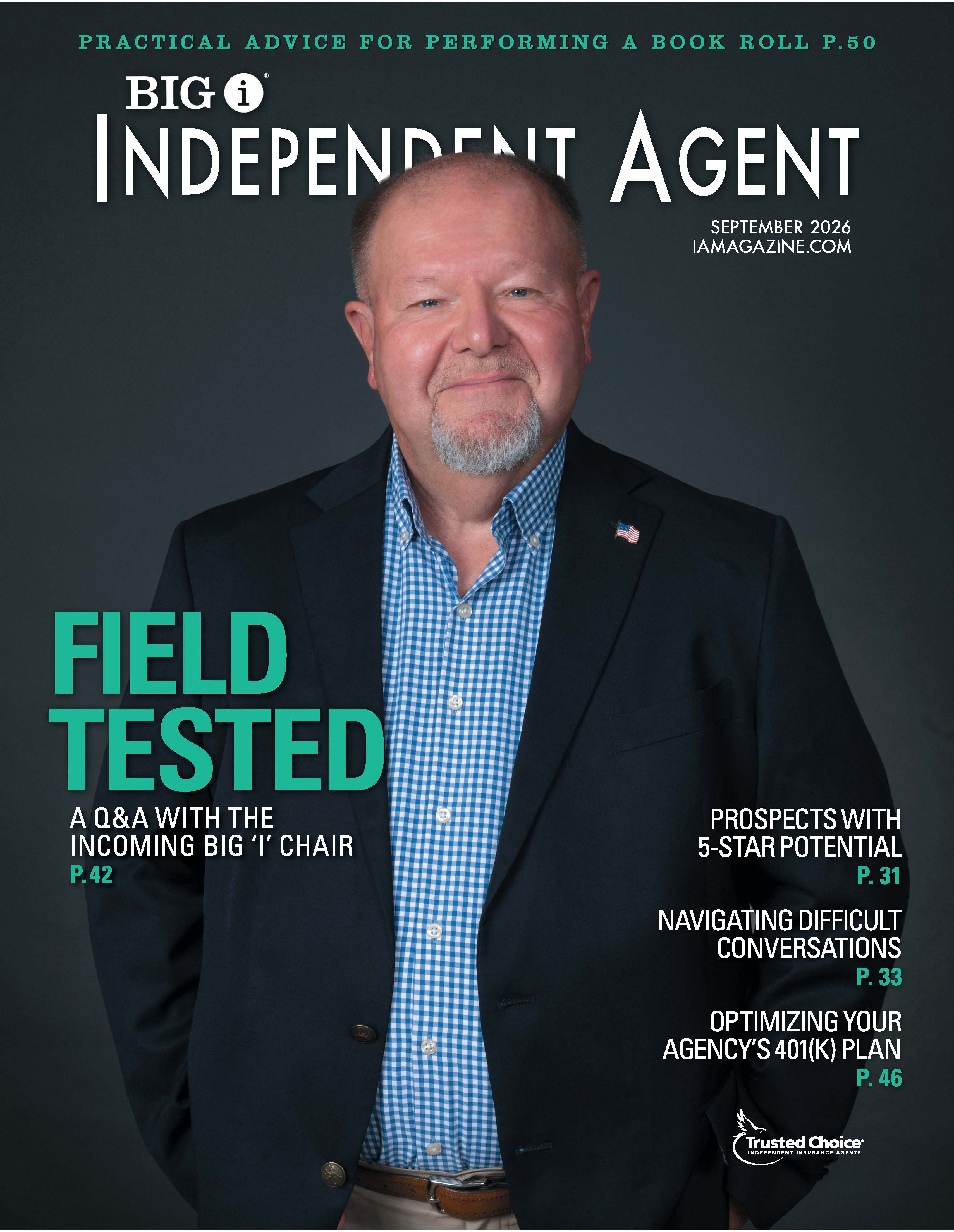
The September issue is out now!