Flood Risk Is Rising: Why Insurance Agents Must Lead the Coverage Conversation
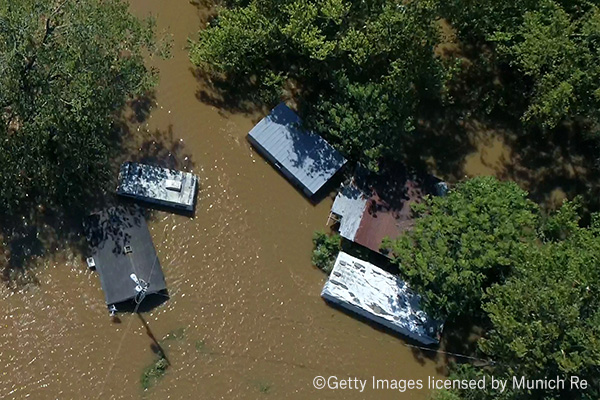
Homeowners in the United States are facing a growing number of threats related to climate change. What we frequently refer to as secondary perils—hailstorms, flash floods, tornadoes and wildfires—are contributing a larger percentage to overall losses in recent years.
Flooding is the most common and costliest natural disaster in the U.S., contributing significantly to overall losses. In 2024, floods caused more than $8 billion worth of damage nationwide. Flooding can strike anywhere, severely affecting homes, businesses and entire communities.
Given the devastating effects of flooding, why are we still seeing a majority of homeowners go without flood coverage?
One reason is due to a lack of education among policyholders. Many homeowners are not aware of their flood risk or that a typical homeowners policy does not cover flooding. While federally backed mortgages require flood insurance for those living in a special flood hazard area, homeowners living outside these zones often do not purchase flood insurance. Data from the First Street Foundation found that there are 14.6 million properties in the U.S. that are at significant risk of flooding, 70% more than what is currently reflected in FEMA’s flood maps.
Despite the increased frequency of flooding events, the National Flood Insurance Program (NFIP) has seen a decrease in the number of flood policies purchased in recent years. The number of NFIP policies has declined from a peak of 5.7 million in 2009 to 4.7 million in May of 2024.
“I think education is really the key point when talking about flood insurance,” said Serena Garrahan, senior vice president, inland flood product manager at Munich Reinsurance America, Inc. (“Munich Re US”). “There’s a lot of uncertainty from homeowners when it comes to flood risk. Generally, people aren’t always the best estimators of their own risk. People have the mentality that it won’t happen to me, but anywhere it can rain, it can flood,”
“We also see a lot of homeowners who might not even be aware that their policies don’t cover flood,” she said. “So it’s important for insurers and agents to talk to policyholders about their flood options.”
Cost and availability are two additional reasons homeowners aren’t purchasing flood insurance. The average cost of a flood insurance policy is $96 per month or $1,152 annually, according to FEMA. With property insurance rates already high for homeowners, ancillary coverages such as flood insurance are often the first place homeowners look to cut costs.
However, advances in flood modeling are making flood insurance more affordable. Rating flood policies using location-specific information allows insurers to better assess and price flood risk, translating to risk-appropriate pricing for policyholders.
While the NFIP remains the primary source of flood insurance, the private market has been growing, giving homeowners more options to protect their homes from flooding. Direct premiums written for private residential flood nearly doubled from 277,000 policies in 2020 to approximately 569,000 by 2024, with premium revenue growing by 240% to $0.5 billion.
Financial Protection
Most property insurance policies, including homeowners, typically exclude coverage for flood damage. Without flood insurance, individuals and businesses affected by floods are left to bear all or most of the costs of repairs and rebuilding their properties. These expenses can be immense, causing a substantial financial drain. Most people, with limited financial resources, are challenged to get back on their feet after suffering a loss.
Flood insurance also plays a critical role in preserving the financial stability of the community as a whole. When widespread flooding occurs, the economic impact can be devastating, leading to declines in property values, loss of tax revenue and disruptions to local businesses. Flood insurance provides property owners with the financial resources they need to rebuild and repair their homes and businesses, allowing communities to bounce back more quickly from the aftermath of a flood.
Protection Gap Solution
Munich Re US helps to close the protection gap by offering a white label flood endorsement for homeowners in low to moderate flood zones. Providing flood coverage on an endorsement basis is an attractive and affordable option. As the frequency and severity of floods continue to increase, investing in flood insurance is more important today more than ever.
Learn more about Munich Re US flood solutions.
Any descriptions of coverage are meant to be general in nature and do not include nor are intended to include all of the actual terms, benefits and limitations found in an insurance policy, which forms the contract between an insured and insurance company, and governs in all cases. Such products and services described here are offered by Munich Re US and its affiliates, which include American Alternative Insurance Corp., The Princeton Excess and Surplus Lines Insurance Company, The Hartford Steam Boiler Inspection and Insurance Company, and American Modern Insurance Group, Inc. Munich Re US disclaims any and all liability whatsoever resulting from use of or reliance upon this article. The inland flood coverage endorsement is not intended to satisfy any mandatory flood insurance requirements of a policyholder’s lending institution for such policyholder’s mortgages or loans. Coverage to satisfy these requirements is available through the NFIP. This inland flood coverage endorsement is not affiliated with the NFIP.

© Copyright 2025. Munich Reinsurance America, Inc. All rights reserved.