Putting the Human Touch on 21st Century Personal Lines
By: Steve Doucette
It seems today when many property-casualty personal lines insurance companies grow up, they wish to become a direct to the consumer (DTC) marketer—a mini-lizard with a local accent. Yet, the DTC model is an industrial centralized model conceptualized in the late 1930’s in an era best symbolized by the telephone—iconoclastic for the 20th century, but hardly a model for the 21st century.
Designing an effective 21st century model for personal lines insurance needs to grapple with some fundamentally different forces than those of the 20th century. Three of these fundamental forces are technology, the capability of today’s agents and, most importantly, the changing and complex demands of the 21st century customer.
The technological revolution of the last 30 years is fundamentally about moving the power of information from the bastion of the institution to the individual. Today, the first access point for information is the Internet.
The Internet creates personal empowerment through information access, and this personal power denudes the central institution’s weaknesses. A central institution like a home office is about control, and the Internet is about empowerment. A personal lines system in the 21st century will appropriately utilize the Internet to destroy the traditional central institution in favor of a more virtual model.
The second 21st century force is the maturing capability and strength of the local agent. Market pressure from many sources over the last 30 years has eliminated weak agents, both small and large, and has left a very educated, entrepreneurial, tech-savvy workforce.
This workforce of agents and their employees is already locally positioned with personal lines customers. These agents are capable of effectively executing customer requirements that have migrated over the last 20 years to the central insurance home or branch office institution.
The third 21st century force is the complex demands of the 21st century customer. The total envelopment of today’s customer in technology has not lessened the complexity of human need. The immediacy and ubiquitous nature of information may be new, but the most fundamental needs of the customer, such as knowledge, trust, accountability, and the immutable personal touch, remain.
An appropriate 21st century model would be a more virtual design which moves information and function to the local level, and ultimately eliminates the role of the traditional, centralized home office in relation to customers. The natural local entity would be the local agent in partnership with the local customer.
In such a virtual model, all transactions formerly performed at the central home office must be able to be transacted in real time at the local agency. Today’s technology juxtaposed with the local agents’ personalities, are capable of satisfying the customer’s complex needs for a competitive cost. In addition, consumers should be able to participate in these service functions if they desire. The ultimate team is agency and local customer, not home office and local customer.
Claims should not be handled by some stranger many miles away from the customer utilizing a 1-800-handoff. Rather, claims should be handled by a local agency customer service representative whom the customer knows and whose face is recognizable. Checks should be released into an electronic delivery system, locally printed and delivered in whatever manner the customer desires, by the agent to the customer.
In such a customer focused virtual model, technology plays an extremely important role, but none-the-less it is a supportive role to the overall business system model which utilizes the personality of the agency as the image and epicenter of service, and not a distant faceless home office.
The traditional carrier home office or branch office does not completely disappear in this new system, but has three ongoing roles. First, the home office still serves as the financial epicenter. Second, it acts as a quality control center performing no customer service functions, but remaining ultimately responsible for customer service quality. Third, it shares co- responsibility for customer marketing and sales.
A 21st century design requires the home office to become directly involved with complimenting agents’ traditional role in marketing and sales. This participation is not another attempt at agency coop advertising, but rather direct entry into marketing and selling of new personal lines customers, and cross selling existing agency customers by the central home office.
This 21st century system is actually a combination of the very effective back- end servicing capabilities of the independent agency system, with the front-end of the most effective of today’s DTC companies. It is recognition that the agency is the most effective way to service customers and their array of complex needs.
Steve Doucette (swd@greatnorthwest.com) is the founder and CEO of two small personal lines insurance companies that operate in 17 states, primarily West of the Mississippi and in Hawaii.
Designing an effective 21st century model for personal lines insurance needs to grapple with some fundamentally different forces than those of the 20th century. Three of these fundamental forces are technology, the capability of today’s agents and, most importantly, the changing and complex demands of the 21st century customer.
The technological revolution of the last 30 years is fundamentally about moving the power of information from the bastion of the institution to the individual. Today, the first access point for information is the Internet.
The Internet creates personal empowerment through information access, and this personal power denudes the central institution’s weaknesses. A central institution like a home office is about control, and the Internet is about empowerment. A personal lines system in the 21st century will appropriately utilize the Internet to destroy the traditional central institution in favor of a more virtual model.
The second 21st century force is the maturing capability and strength of the local agent. Market pressure from many sources over the last 30 years has eliminated weak agents, both small and large, and has left a very educated, entrepreneurial, tech-savvy workforce.
This workforce of agents and their employees is already locally positioned with personal lines customers. These agents are capable of effectively executing customer requirements that have migrated over the last 20 years to the central insurance home or branch office institution.
The third 21st century force is the complex demands of the 21st century customer. The total envelopment of today’s customer in technology has not lessened the complexity of human need. The immediacy and ubiquitous nature of information may be new, but the most fundamental needs of the customer, such as knowledge, trust, accountability, and the immutable personal touch, remain.
An appropriate 21st century model would be a more virtual design which moves information and function to the local level, and ultimately eliminates the role of the traditional, centralized home office in relation to customers. The natural local entity would be the local agent in partnership with the local customer.
In such a virtual model, all transactions formerly performed at the central home office must be able to be transacted in real time at the local agency. Today’s technology juxtaposed with the local agents’ personalities, are capable of satisfying the customer’s complex needs for a competitive cost. In addition, consumers should be able to participate in these service functions if they desire. The ultimate team is agency and local customer, not home office and local customer.
Claims should not be handled by some stranger many miles away from the customer utilizing a 1-800-handoff. Rather, claims should be handled by a local agency customer service representative whom the customer knows and whose face is recognizable. Checks should be released into an electronic delivery system, locally printed and delivered in whatever manner the customer desires, by the agent to the customer.
In such a customer focused virtual model, technology plays an extremely important role, but none-the-less it is a supportive role to the overall business system model which utilizes the personality of the agency as the image and epicenter of service, and not a distant faceless home office.
The traditional carrier home office or branch office does not completely disappear in this new system, but has three ongoing roles. First, the home office still serves as the financial epicenter. Second, it acts as a quality control center performing no customer service functions, but remaining ultimately responsible for customer service quality. Third, it shares co- responsibility for customer marketing and sales.
A 21st century design requires the home office to become directly involved with complimenting agents’ traditional role in marketing and sales. This participation is not another attempt at agency coop advertising, but rather direct entry into marketing and selling of new personal lines customers, and cross selling existing agency customers by the central home office.
This 21st century system is actually a combination of the very effective back- end servicing capabilities of the independent agency system, with the front-end of the most effective of today’s DTC companies. It is recognition that the agency is the most effective way to service customers and their array of complex needs.
Steve Doucette (swd@greatnorthwest.com) is the founder and CEO of two small personal lines insurance companies that operate in 17 states, primarily West of the Mississippi and in Hawaii.
This month’s issue
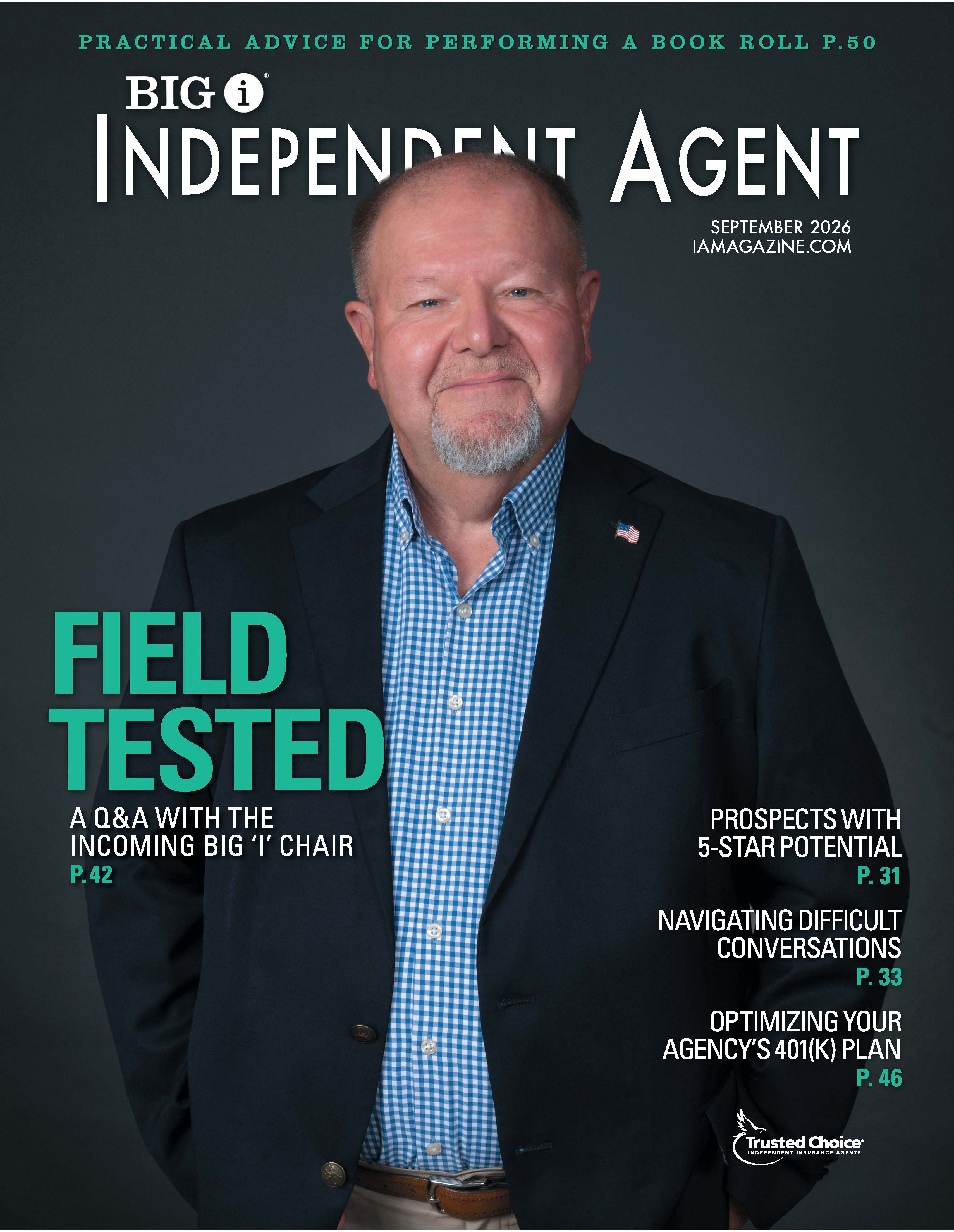
The September issue is out now!