Insuring Volunteers Through Personal Lines
By: Bill Wilson
This is an important question given a recent $18 million Wisconsin court judgment against a volunteer and church charitable organization for a negligent auto accident. While most personal lines insureds don’t carry limits anywhere near this high, reasonably large verdicts are not that unusual.
Generally speaking, both the homeowners and auto policies provide coverage for non-business activities. However, they only cover bodily injury and property damage. For example, an unendorsed homeowners policy may not cover personal injury like slander and almost never covers financial loss arising from poor decisions, errors and omissions.
Under a personal auto policy, exclusions like “transporting persons or property for a fee” may come into play for volunteer activities like Meals on Wheels or providing rides for the elderly to church, shopping or medical facilities when the driver has an expense reimbursement.
To read the complete analysis of these exposures and why certain exclusions may or may not apply, click here.
Volunteer Coverage Under Commercial Lines
Many organizations use volunteers to transport kids and senior citizens or provide personal services in homes or medical facilities. How are these uncompensated volunteers treated from a coverage standpoint compared to employees? When it comes to workers’ compensation, you maybe in for a shock.
Under the ISO business auto policy, volunteer exposures can be addressed pretty simply with the right auto symbol(s). Under the current ISOCGL policy, volunteers are considered insureds for both liability and medical payments…under older editions, coverage might need to be endorsed.
The real problem arises under workers’ compensation because the laws vary in each state. NCCI provides a Voluntary Compensation and Employers Liability Coverage Endorsement, WC 00 03 11 A, to add “voluntary compensation insurance” to the workers compensation policy.
The question is whether this endorsement is designed to (or can)be used to insure purely uncompensated volunteers or if its purpose is to voluntarily cover compensated positions like agricultural, domestic and casual workers normally exempted from many state laws.
Preliminary investigation of this issue reveals that there is a lot of confusion and disagreement about how this endorsement is used. The fact is it may be misused in states where the underwriter is unfamiliar with state law.
To read the complete analysis of volunteer exposures and commercial lines products, click here.
Coverage for Loss Due to Credit Card Fraud
An insured accepted an order via the Internet for products he sells. He verified the credit card was valid through a service he uses. It was not until several days later that the service advised him that the credit card had been stolen. He shipped the product and is now without the product and lost the income. Is there any insurance product to cover this exposure?
With the growing number of Internet transactions, credit card fraud is becoming an increasing problem. However, it doesn’t just affect online sales—it can affect catalog, phone or in-store sales as well. The defrauded credit card holder is typically out only $50, the credit card company virtually loses nothing and the merchant is left holding the bag.
Credit card fraud has become one of the primary sources of risk and loss for retailers. The question is, can and should this be insured? Or is this simply a business risk that must be borne by the retailer or managed in some way other than insurance?
There is no “standard” product for this exposure. For most businesses the risk may not be insurable, at least not at an affordable price. That leaves specialty products and alternative risk management approaches. In this article, we examine ten claims scenarios, touch on one merchant fraud product and identify some Web sites that address procedures and loss control measures that can be implemented to reduce, if not eliminate, this type of fraud.
To learn more, click here and read the entire article.
Bill Wilson (bill.wilson@iiaba.net) is Big “I” director of the Virtual University, an online learning center for agents and brokers.
This month’s issue
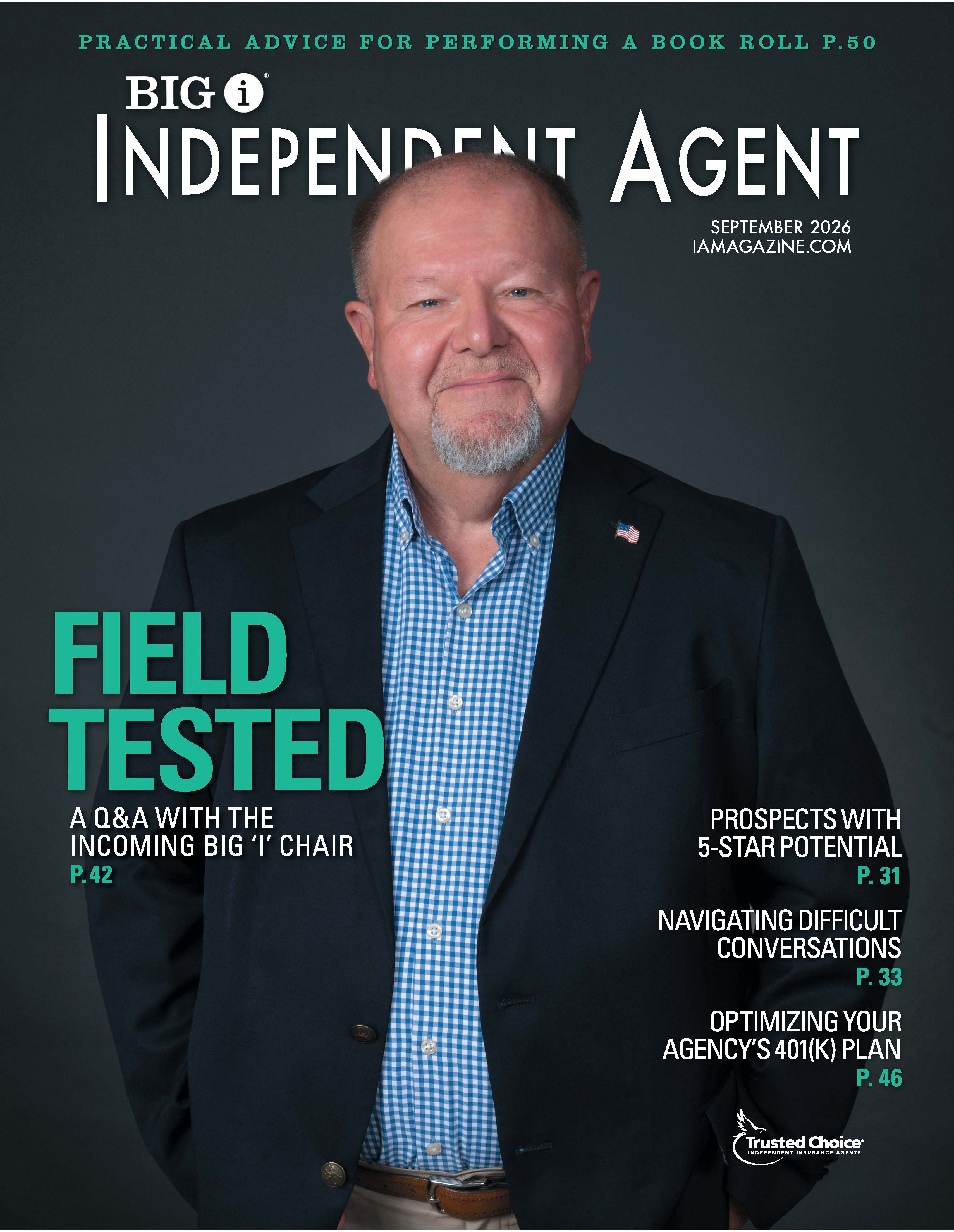
The September issue is out now!