Where Agents and Carriers Intersect
By: Susan L Hodges
Dwayne David is as much a news reporter as he is an insurance agent. Three times a year, the owner of Knox Insurance Group in Lafayette, La., travels to Seattle to meet with the head underwriter of one of his carriers. He also visits other locales where agency’s carriers are situated and hosts company executives in Lafayette. It’s not that David is looking for advertising subsidies or other forms of assistance. Quite the opposite, actually. He comes bearing gifts—pearls of information about what’s going on in southeast Louisiana, which is a lot these days.
“The dynamics down here are extremely complicated,” David explains. “We’re probably going through the biggest boom our economy has seen in the last 25 years.” No wonder: Since Hurricanes Rita and Katrina wiped out virtually all of the oil and gas facilities near the Gulf Coast, billions of dollars are now being spent to replace them—and to add new ones. What’s more, these offshore drilling platforms, onshore refineries and onshore gas plants are all being built stronger than ever to withstand future hurricanes.
Money for these projects is coming not from the federal government but from plant owners, oil companies and insurance carriers. And the unprecedented volume of business is changing the insurance needs of construction companies doing the work. “We have one client who made more profit in 2006 than cumulatively in the past 20 years,” David says. Such huge revenues are allowing construction companies not only to hire more workers, but to develop safety programs, take large retentions and supply health benefits to their work forces.
“The more we can tell a carrier about what’s going on in the playing field, who the competitors are and what they’re doing, and the general direction of our clients that are growing, the more our agency-company relationships will be enhanced,” David says. Carriers aren’t set up to spend days in the trenches, drinking coffee with agents and clients to gather intelligence. David knows that, and tries to fill the void. He channels information not only to company underwriters, but to loss-control representatives, claims adjusters and top management. “Wherever we see an opportunity to give advice or information that can help them,” David says, “we do it.”
When was the last time you fed your carriers? Of course you feed them business, but when was the last time you served up some strategic information about your community? Consultants, carriers and certain agents believe that, in general, agents need to be more proactive to develop and maintain close relationships with the companies that provide their products.
Beyond Quotas
According to Jerry Mallicoat, chief marketing officer for Ohio Casualty Group (OCG), the ideal agent-carrier relationship is about more than meeting numbers. “It’s not just about producing a number, although that is certainly important,” he says. “It’s about a strategic relationship for the long term and taking a longer-term view.”
Many carriers say that what distinguishes their best agents is a true partnership and sense of camaraderie. “Our goal is to align ourselves with partnership-minded agents that are winning and growing in their local marketplace,” says Dick Lavey, The Hanover Insurance Group’s vice president of field operations, marketing and distribution. “We believe agents that are sales focused and have a value-added client orientation and not just a price orientation, are winning agents.”
Clyde Fitch, senior vice president, distribution development at Travelers, agrees. “The best agents assess the options and opportunities and fuse them into a winning result for all parties,” he says.
At Ohio Casualty, the relationship begins with agents understanding how to write profitable business. The multi-lines carrier dedicates significant time to training agents and communicating with them to determine synergistic matches between OCG’s markets and potential customers. “We’ve mined our own data to understand what we do well,” Mallicoat says. “We want to work with agents who understand where our market opportunities are and which classes of business are the right fit for us and their customers.”
OCG also wants its agents to have or to adopt a strong program for growth. And for those willing to try newer tactics, Mallicoat says OCG is discussing ways to apply its resources online. “We might co-brand a special site that we list in an ad for a product,” Mallicoat explains. Prospects could then visit the Web site, enter information to pre-qualify themselves and submit the information to OCG, which would in turn funnel the data to the appropriate agency. “Most of our agents are very receptive to the idea,” Mallicoat says. “They’re dabbling in [online marketing] themselves, and when they hear that we’re interested in participating, they’re delighted.”
Ohio Casualty Group was an early endorser of agency download and one of the first to provide real-time rating. In return, OCG expects a similar commitment to technology from its agents. “Technological advancement shows that an agency is future-oriented and dedicated to continuous improvement,” Mallicoat says. Agencies already intimate with the Internet will find it easier to increase their marketing and service to policyholders online. “Especially for emerging generations that expect on-demand sales and service, this is an important element of marketing,” Mallicoat adds.
Educational Tools
Clearly, relationships between agencies and carriers are a two-way street. Agents have a responsibility not only to sell products, but to operate in an ethical manner and adhere to good business practices. Similarly, carriers owe it to agents—and to themselves—not only to offer sound products and competitive rates, but to make it as easy as possible for agents to do business with them.
“Independent agents need to put technology to work,” says Mark Friedlander, The Main Street America Group’s director of corporate communications. “Most agencies are demanding it and most carriers are diligently building ‘easy-to-use’ functionality. Agencies need to help carriers’ investments in technology pay off.”
The Hartford dedicates entire field teams to educating agents. One team, called STAAR (short for Staff Trainers and Automation Resources), trains agents to use the company’s automation systems to achieve the highest functionality possible. Team members, deployed in local markets around the country, teach employees at every agency level (CSRs, producers and principals) how to use the company’s technology to make their work more efficient and effective. The STAAR team is now building a curriculum to help agents take greater advantage of the Microsoft platform.
“Our sales model is all about solutionbased selling,” says Jim Griesing, Sales Excellence vice president of The Hartford. This model requires that everyone at the carrier, from the executive level to the front-line sales force, has a deep understanding of the agency perspective. Each agency is assigned a sales representative whose job is to focus on that agency, understand its needs and bring forth Hartford products and solutions to address those needs. Depending on its sales goals—whether in personal lines, small commercial or middle market/large account—each agency has access to a sales representative who specializes in that particular market. Another team effort aimed at agencies is The Hartford School of Insurance.
“Our training is in response to agents telling our senior leadership team that they needed an outlet for training,” says HSI Director Shirley Woods. “They heard over and over again that carriers once provided agent education, but moved away from it in the 1980s. [So] in 1998, The Hartford established its school to help agents grow organically, recruit, train and retain top talent and reduce expenses by delivering insurance training when and where agents need it.”
Until 2004, classes were limited to Hartford and Orlando. But in 2007, programs will take place in 15 cities, from Anaheim to Baltimore. Demand thus far has been so high in cities like Atlanta and Chicago that classes filled two months in advance, prompting HSI to hold two or even three programs where it had originally scheduled just one.
Current offerings include five entry-level programs, three for producers and two for CSRs, and two intermediate classes for producers. In what seems a savvy move on the part of The Hartford, HSI classes are open to all agents or CSRs, whether their agency represents the carrier or not. In this way, the company demonstrates its commitment to independent agents—and hopes to become a top carrier in the agencies that participate. “We truly believe that by educating folks early in their career and giving them the right tools, they’ll get a kick-start—and will be loyal to us,” Woods says.
Brec Woodbridge is happy to comply. An account executive with Lockton Insurance in San Francisco, Woodbridge moved to the brokerage from a position in corporate risk management. He took Hartford’s commercial lines development course to refresh his knowledge of the agency/brokerage side of the business.
“It was great,” Woodbridge says. “The class gave me an incredibly good understanding of the underwriting side, and I learned how to interact with clients and how to think ahead. I still use the books and binders they gave us every day. Other colleagues use them, too.”
Be Up Front
If carriers can invest time and money in their agency relationships, agents should be able to, too. Chris Burand, an insurance consultant and president of Burand & Associates, LLC, says one way to do this is to take the time to become more aware of the financial situation of each of your companies. Knowing where your companies stand in terms of their own growth and market share can provide insight into carriers’ volume requirements, Burand says, and may help you negotiate better terms regarding your own obligations to each carrier. For example, an agency may be allowed to underwrite up front “and get a better price, even in the soft market, provided companies are willing to work with them.” Burand says.
Up-front underwriting injects flexibility into the placement process so that companies and agencies can more easily address each situation while remaining responsibly competitive, Burand says. In other words, companies can write business more profitably, which may result in higher commissions for the agency. Up-front underwriting can also mean lower premiums in some instances, benefiting the client and possibly increasing client trust and loyalty to the agency. As Ohio Casualty Group’s Mallicoat puts it, “Agency-company relationships are really about collaboration.” An ideal agency “understands the value a wellinformed carrier can bring to the agency’s relationship with its clients,” Mallicoat says. Thus, the agency’s job is to convey information—and the carrier’s job is to provide products and services that reflect that information.
“Trust is absolutely No. 1 our list,” echoes Friedlander of Main Street America. “Independent agents represent our brand in the market and are our direct face to the consumer.”
Susan L. Hodges (hodgeswrites@aol.com) is an IA senior contributing writer.
Carriers & Your Book of Business
Of course your carriers want you to succeed—you’ve built a book of business for them, and it’s only natural that they want to protect it and see it grow. But what if you’ve failed to create a perpetuation plan? If you sell your agency, your carriers could lose all of the business you’ve placed with them when a new owner decides to roll those insureds to another company. Knowing this, some carriers are analyzing agencies’ ability to perpetuate—and offering those at risk new services to help find a solution. Marsh-Berry is one firm helping carriers do this.
“We’ve trained field representatives to perform the assessment,” says Albert Lloyd, executive vice president of the Connecticut-based consulting firm. After identifying an at-risk agency, Marsh-Berry professionals offer four sessions over the course of a year to help the firms’ owners choose and begin to implement a perpetuation program.
“We think the companies going down this road are much more progressive than others,” says Doug Terrill, Marsh-Berry senior vice president.
Here’s why: Agencies with less than $5 million in revenue are consolidating and selling out faster than any other agency segment. And according to Lloyd and Terrill, it takes six employees to produce two employees who can buy out a single owner. Generally, two people are required to buy out one owner, due to the amount of debt taken on and the revenues needed to service it. But more than a few agencies have put off perpetuation so long that it’s no longer an option. These are the agencies that must sell.
Interestingly, at least one regional carrier is considering buying these dying agencies and running them until a suitable buyer is found. Lloyd says a few other regional carriers are taking a different approach by trying to match up these agencies with others that could be a good fit. “In a way, these companies are looking at their own perpetuation,” Terrill says. “They know if they can preserve their books of business, they’ll be that much more successful.”
Another Perspective: More Isn’t Always Better
If you’re struggling to meet volume requirements for a slew of carriers, consultant Chris Burand has this suggestion: Why not consider contracting with fewer of them? “Smaller agents often think they have to go out and find new markets to meet volume requirements when they could probably do with fewer standard carriers,” says Burand, president of Burand & Associates LLC. By committing to fewer companies, an agency frees itself to write more and better business for the carriers it still has.
And if the need arises for coverage from a carrier with which you no longer contract, Burand notes that you still can write that coverage through a general agent. “You may earn a little less commission,” he concedes, “but you’ll make it up in additional business with other carriers that result in higher commissions or contingency income.”
Burand also encourages smaller agencies to take a fresh look at the excess & surplus (E&S) market, which has grown roughly 400% during the past five years. E&S markets are now easier to access than they once were and can provide opportunities for agents to write a variety of unusual or high-risk coverages that they couldn’t write before. And again, agents may be able to avoid the volume commitments with E&S insurers that they incur in the standard market.
This month’s issue
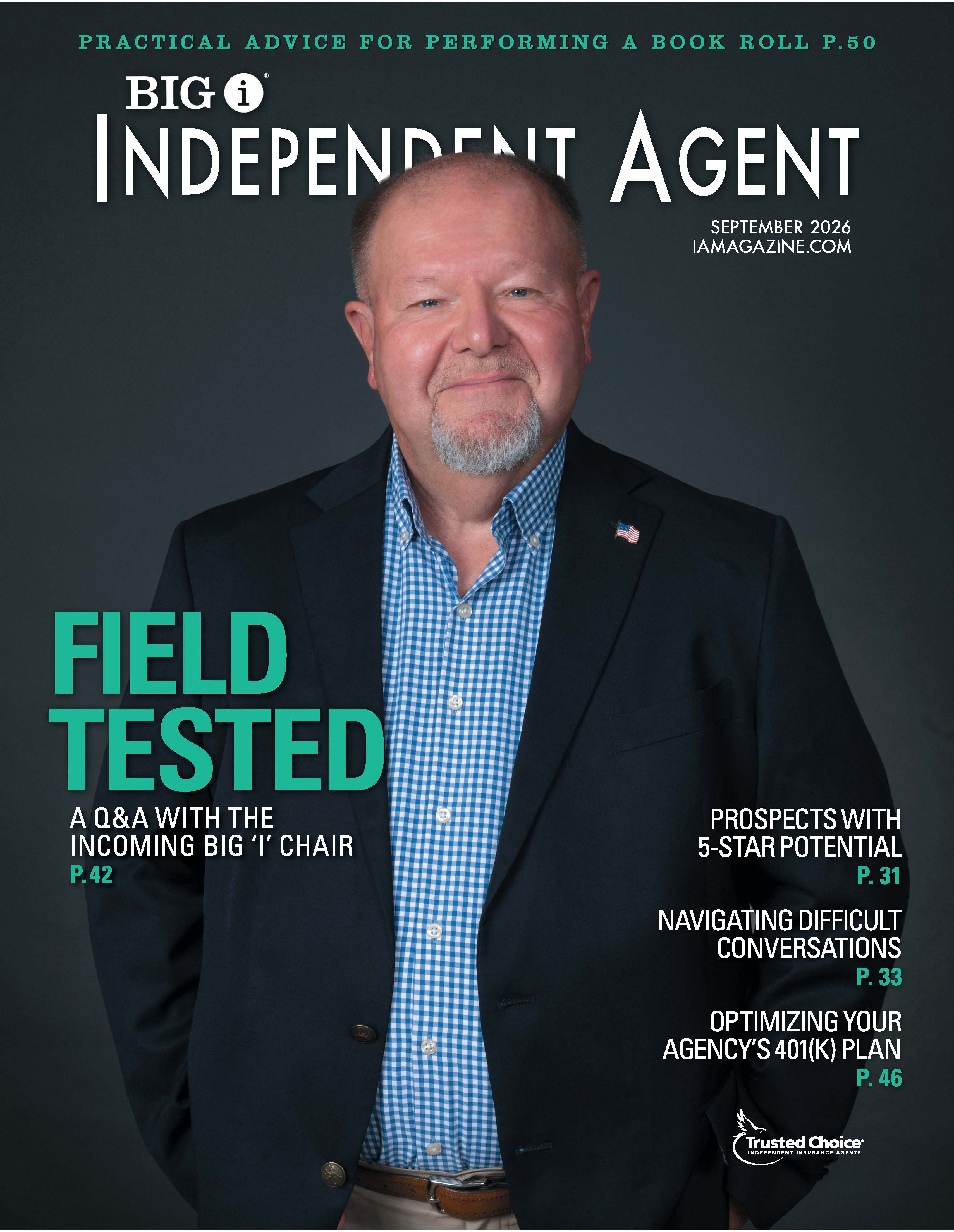
The September issue is out now!