Buckle Up: Transporting Kids to School Events
By: Bill Wilson
As a parent, do you ever transport high school (or other) kids to athletic or other school events? Do you use your own vehicle or a nonowned vehicle like a private passenger auto or van? Do you have a liability exposure? Do you have coverage under a PAP?
My son is a high school senior. Since he was a freshman, he’s played on the school’s golf, baseball and basketball teams. He’s also in the band and attends a variety of math and academic competitions. During that time, I’ve hauled him and his friends to and from practices and games, as well as numerous off-campus events, as have many other parents and faculty. Sound familiar?
His school requires students from seventh grade on to participate on at least one athletic team. As a result, there is a need to provide transportation during and after school for hundreds of students throughout the year. This can pose a significant risk. If one of us has an accident, will our PAPs respond to the claim? What if parents drive rented vans?
The biggest exposure for parents and student drivers transporting students is the adequacy of limits. For faculty members, since this involves a work (i.e., “business”) activity, coverage concerns are greater, particularly when operating nonowned autos.
For a VU faculty discussion of these issues, click here.
Workers’ Compensation and Illegal Immigrants
According to the Pew Hispanic Center, 11 million to 12 million illegal aliens reside in the United States. Illegal immigrants account for almost one-third of all foreign-born U.S. residents, and close to 80% originate from Mexico and other Latin American countries.
Of the 9.3 million illegal adults, 7.2 million (77%) are employed and account for about 5% of the entire U.S. workforce. However, they comprise a far more disproportionate percentage in some industries, such as 24% of farm workers, 17% of cleaning workers, 14% of construction workers and 12% of food preparers. Within an industry, illegal workers may comprise high percentages of specific (often more hazardous) occupations. For example, it is estimated that 36% of all insulation workers and 29% of all roofing employees are illegal aliens.
Because of language barriers and lack of training and experience, some experts believe that the exposure to injury may be significantly greater for illegal aliens than other workers. According to an Associated Press article, Mexican workers are about 80% more likely to die from a work injury than native-born workers. In several southern and western states, these workers are four times more likely to die than U.S. citizens performing similar jobs.
Do state workers’ compensation laws cover illegal aliens? Will the influx of aliens into the workplace cause poorer loss experience and increased workers’ compensation premiums? While the jury is still out on the second question, the first can be answered in states that govern the issue by statute or that have tested it in court.
For a complete analysis of this issue, including a downloadable state-by-state listing of statutes and case law, click here.
The Virtual University “Ask an Expert” service recently received a question regarding liability and medical payments coverage for a foreign exchange student killed while riding the ATV of the family she was staying with. The VU faculty members’ commentary on this potential claim may be appropriate in any situation where a non-family member/resident is in the care of an insured.
From an HO coverage standpoint, “there is no Med Pay for anyone residing on the premises,” one faculty members said. “There is no liability coverage for BI to an ‘insured.’ The definition of an ‘insured’ includes anyone under the age of 21 in the care of someone who is an ‘insured.’ I doubt that there is coverage…exchange students are probably one of the most common examples of this HO policy provision by insurance instructors. Your best bet is to hinge your claim for coverage on the exchange student being a guest and not a resident.”
Do you agree? For opposing viewpoints, click here. To learn more about experience rating, check out the VU’s online course on experience rating.
Bill Wilson (bill.wilson@iiaba.net) is Big “I” director of the Virtual University, an online learning center for agents and brokers.
This month’s issue
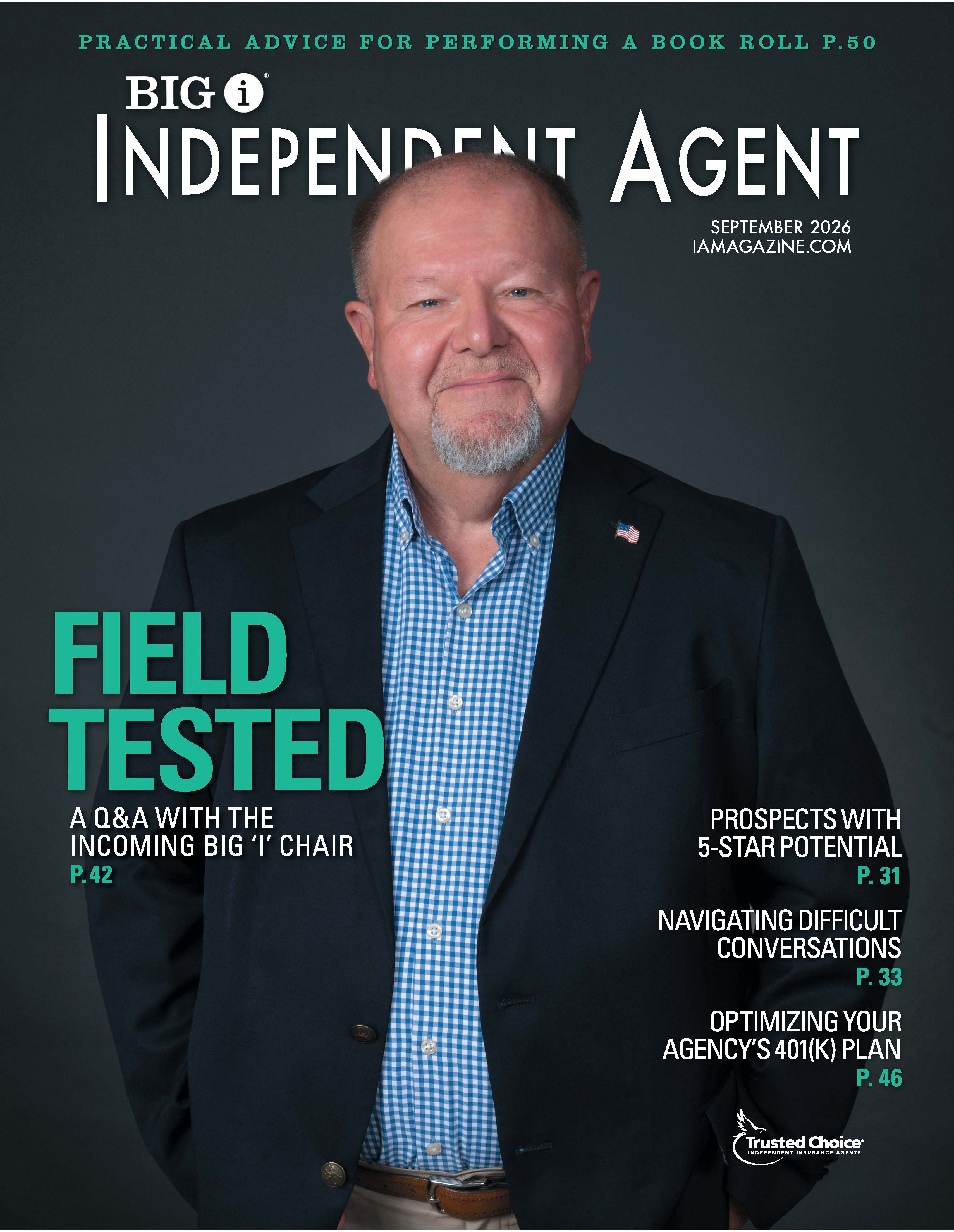
The September issue is out now!