5 Minute Fixes That Prevent E&O Claims

By Annette Ardler
Errors & omissions claims rarely erupt from a single catastrophic mistake. More often, they grow quietly from oversights, informal shortcuts or assumptions that feel harmless in the moment but carry costly consequences later. The good news? Many of the riskiest behaviors can be corrected in under five minutes.
Drawing on guidance from underwriters, claims specialists, agency consultants and defense counsel, here are a series of quick, practical steps agencies can take to meaningfully reduce E&O exposure—without overhauling workflows or adding headcount—starting with the don’ts.
Don’t overlook renewals. A missed renewal remains one of the most preventable—and damaging—E&O claims. Set a 120-day suspense after every new business or renewal. When it pops up, confirm that the policy is on your renewal list. If not, add it immediately. This simple habit creates a safety net for the entire renewal cycle.
Don’t accept cash or direct bill payments. Cash and direct-bill handling can become a ticking liability time bomb. Between late payments, disputed handoffs and missing receipts, the margin for error is razor thin. Agencies should refuse these payments entirely and direct clients to electronic funds transfer (EFT) or mail instead. Yes, even hand customers a stamp if necessary. “For their protection” isn’t just a line; it’s the truth.
Don’t make yourself responsible for driver changes. Unless you are handling a rare named driver policy, asking clients to notify you every time they add or remove a driver creates unrealistic expectations—and E&O exposure. Position the insured as responsible for maintaining accurate lists and reporting changes during review periods.

Risk management resources for Big “I” Members
Don’t run motor vehicle records (MVRs) for clients. Running MVRs for clients introduces privacy concerns, creates an unnecessary administrative burden and expands your liability. All states now make self-service MVR access inexpensive and easy for applicants.
Don’t let pending items fall through the cracks. Every pending task—even if it’s a “I’ll handle it in the morning”—deserves a suspense. This ensures continuity if you’re out sick, on vacation or simply pulled into another task. It’s the easiest way to prevent something from going missing in the handoff.
Don’t assume uninsured/underinsured motorist is included in an umbrella. One of the most expensive E&O claims comes from umbrella policies lacking UM/UIM coverage. Many umbrellas exclude it, and failure to offer or document rejection has led to massive E&O payouts. Always offer, always document.
Don’t hide behind acronyms and jargon. Never assume clients understand insurance abbreviations. What seems common to industry professionals—CGL, BI, EPLI, UM/UIM—can be gibberish to customers. Unexplained jargon creates misunderstanding and misaligned expectations.
And here are some dos that take five minutes but have outsized protective power:
Get signed renewals—every year. Even with electronic workflows, print and obtain signed renewal applications annually. This small step becomes invaluable when disputes arise about coverage selections, particularly in property or undervaluation claims.
Request all underlying policies. When umbrella and primary coverage are placed with different agencies or an insured places coverage on their own, gaps often go unnoticed. Don’t assume you place all of your customer’s insurance. Asking for underlying policies allows you to confirm minimum limits and compatible coverage, preventing uncovered losses.
More On E&O Loss Control



Confirm all recommendations in writing. Whether advising increased limits, new coverages or changes in deductibles, follow up every recommendation with a brief email or letter. Written confirmation transforms advice from “he said/she said” to defensible documentation.
Check for hired/non-owned auto. Every business client needs this coverage under their commercial general liability policy. Overlooking it may expose the agency if your customer’s employees use personal vehicles in business operations. A quick review eliminates a major gap.
Let clients provide their own values. Customers should provide equipment and inventory values to establish the basis for business interruption limits. Document your coverage recommendations and their responses. Inflation and supply chain disruptions have made valuation accuracy more important than ever.
Be careful with surplus lines forms. Nonadmitted carriers often use nonstandard forms. Exclusions may differ drastically from admitted markets. Reviewing wording prevents unintended gaps, especially around prior claims, awareness or specialty exposures.
Use declination of coverage forms. When customers reject higher limits, umbrellas, employment practices liability insurance or other recommended coverages, having them sign declination forms provides essential protection.
Document policy changes immediately. Whenever a customer requests a change, send a quick email confirmation. It documents your action and keeps everyone aligned.
Enter transactions in real time. Make entries while the customer is on the phone. Even a small delay can cause lost notes, forgotten steps or misinterpretations. Real-time entry eliminates accidental omissions.
Record cancellations the moment they arrive. Failing to record a cancellation can lead to certificates being issued or claims being reported on lapsed policies. Enter them immediately and update system statuses.
Stop chasing late payers. Chronic late-paying customers increase agency workload—and risk. Stop sending reminders. Verify payment via the carrier site instead and advise clients in writing that reminders will cease. Encourage EFT enrollment.
Discuss renewal premium increases before remarketing. When premiums rise, don’t rush to remarket. Investigate the cause, then call the customer to discuss a plan. Remarketing too quickly saves money but often at the cost of reduced coverage and increased E&O exposure.
E&O prevention doesn’t always require sweeping change. In fact, many of the most effective strategies take less than five minutes to implement. By adjusting daily habits—suspenses, written confirmations, real-time entries, client signatures and careful wording—agencies can dramatically strengthen their defense against claims.
Annette “Nettie” Ardler is a senior underwriter and risk management expert underwriting insurance agents’ E&O coverage for Swiss Re Corporate Solutions. She has been a licensed agent for over 30 years with a specialty in professional liability insurance.
This article is intended to be used for general informational purposes only and is not to be relied upon or used for any particular purpose. Swiss Re shall not be held responsible in any way for, and specifically disclaims any liability arising out of or in any way connected to, reliance on or use of any of the information contained or referenced in this article. The information contained or referenced in this article is not intended to constitute and should not be considered legal, accounting or professional advice, nor should it serve as a substitute for the recipient obtaining such advice. The views expressed in this article do not necessarily represent the views of the Swiss Re Group (“Swiss Re”) and/or its subsidiaries and/or management and/or shareholders. Copyright 2026 Swiss Re.
Agency Management Solutions
Big I Programs
This month’s issue
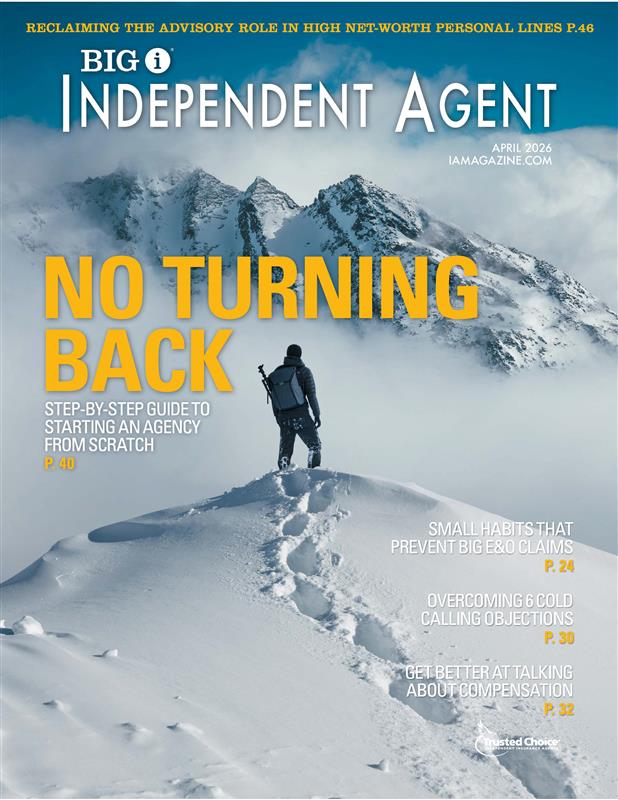
The April issue is out now!