4 Tips to Improve Product Liability Submissions

With the challenges manufacturers and distributors face in today’s evolving product liability market, agents can help their clients secure the coverage they need by understanding the carriers’ appetite and capitalizing on opportunities they offer.
In today’s market, “carriers are inundated with submissions,” says Samantha Artruc, assistant vice president at Amwins Brokerage. “We hear time and again that when a submission lacks quality, it gets pushed to the bottom of the pile. Strong, complete submissions stand out—and that’s critical right now.”
Here are four ways agents can add value to their client relationships and ensure their submission is not placed at the bottom of the underwriter pile:
1) Maintain strong partnerships. “Every manufacturer differentiates itself through unique products or processes, and understanding these distinct risk profiles is critical,” says Erika Melander, national manufacturing practice leader, Nationwide. “Partner with a carrier that has deep expertise in the product manufacturing marketplace and specialized resources to help clients manage and mitigate their risk. Strong partnerships with knowledgeable carriers enhance understanding and deliver tailored protection.”

2026 Big “I” Legislative Conference
April 22-24 Washington D.c.
With support from carriers, agents can also educate clients about potential risks. “Host webinars or organize one-on-one breakfast or lunch-and-learn sessions,” says Ania Caruso, national casualty president at Risk Placement Services (RPS). “I call it ‘low cost but high impact,’ because these tools allow you to present claim scenarios and demonstrate how coverage works in real-world situations.”
“Partnering with carriers that offer additional services at no extra premium can not only enhance the value provided to clients but also elevate the profiles of both agents and carriers,” Caruso says.
2) Communicate effectively. In every insurance market, clear and frequent communication is key to ensuring agents are acquiring the coverage their clients need. “If underwriters come back with questions, be direct and accurate—don’t guess,” Artruc says. “You’ll often see ACORD forms completed for the insured, but this isn’t the time for a one-size-fits-all approach. This is specialized coverage, and submission quality is the differentiator—we’re selling the client’s story, and we need to do it accurately.”
Regular check-ins can assist both the client and the agent. “Make sure you’re staying in close contact with the insured,” Artruc says. “This is not a once-a-year or twice-a-year conversation, it’s frequent check-ins, supplier audits, recall simulations, all the things you need to do to be proactive instead of reactive.”
3) Specialization is good. “Ultimately, a client wants to work with a specialist, so speaking the language of the client and understanding what matters—what keeps that manufacturer up at night—is key,” Caruso says. “Build long-term loyalty through being there to pick up the phone when the claim arises.”
More on Product Liability



Agents who continue to build upon their product liability knowledge become “so well versed that people seek them out,” says Gary Grindle, executive vice president, Amwins Brokerage. “The quality of what you’re able to provide speaks for itself.”
4) Identify coverage gaps or policy details. Agents need to understand their clients’ risks and the coverage they need. “The focus should be understanding the product so that an agent and insured understands ahead of time what exclusions are important to look for,” Grindle says. “And to make sure that whatever carrier or wholesaler you’re working with is adding value to their service and helping agents understand what is covered, and more importantly, what is excluded.”
Additionally, “agents need to have an understanding of where the products are being manufactured and distributed and what the jurisdiction is,” Caruso says. “Also, if a product is discontinued, it’s important to understand how the policy addresses this and determine if there is a need to purchase extended reporting or tail coverage for long-term liability. Sometimes a policy may exclude a certain design or a manufacturer, so make sure you read any exclusionary endorsements.”
Olivia Overman is IA content editor.
Agency Management Solutions
Insurance Markets
Big I Programs
This month’s issue
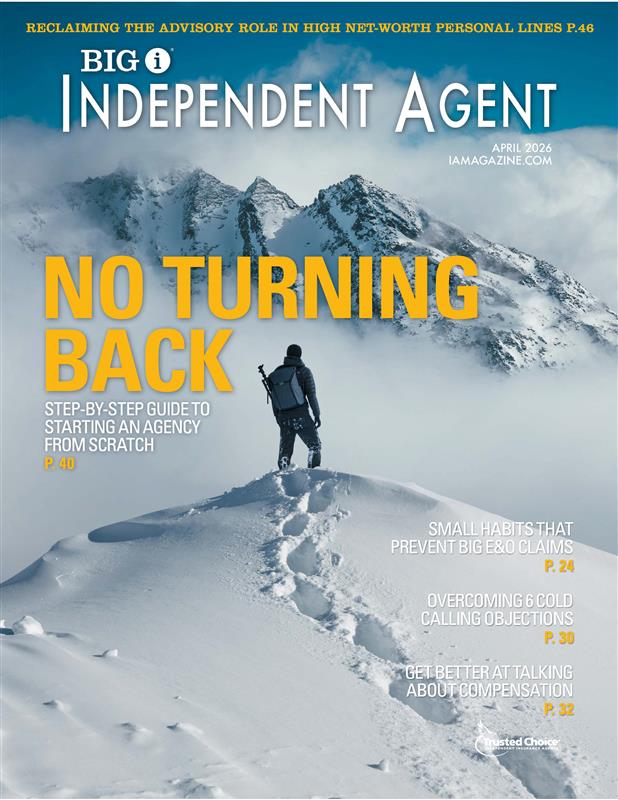
The April issue is out now!