5 Areas Collaboration Can Create a Win-Win for the Insurance Industry

By Kasey Connors
At Ivans Connect 2025, the Big “I” Agents Council for Technology hosted 10 roundtable sessions that brought together a cross-section of the insurance industry—independent agents, carriers, MGAs and technology providers.
The conversations weren’t just about tools and systems; they were about the people who use them, the friction they face and the future they want to build. The roundtables focused on three main topics: data, artificial intelligence (AI) and connectivity.
The data roundtables brought a key issue to the surface: Stakeholders aren’t short on data—they’re overwhelmed by its inconsistency. Different formats, optional fields and varied interpretations are slowing automation and creating rework.

make Your Voice heard at the 2026 Big “I” Legislative Conference
April 22-24 Washington D.c.
One participant boiled it down to: “We’re not fighting the availability of data; we’re struggling to access and structure it consistently.”
Yet, AI is delivering value. Those roundtables found that the burgeoning technology is saving time, improving accuracy and reducing risk. However, confusion persists around what AI is, how it differs from automation and how to implement it responsibly.
Meanwhile, systems are more integrated than ever, according to the connectivity roundtables, but usability is suffering due to imbalances between security and user experience. Multifactor authentication (MFA), outdated workflows and siloed platforms are creating friction for agents trying to serve clients in real time. “Security is essential—but not at the cost of usability,” according to one participant.
More on Technology and Tools



Looking toward the future, participants imagined a world where agents spend less time typing into forms, application programming interfaces (APIs) power seamless collaboration between systems, and technology supports rather than replaces human expertise. They envisioned standards that enable clean data exchange and faster service.
As one participant put it, “Win-win means agents have the tools, carriers get clean data and the customer never feels the friction.”
Here are five areas where participants identified that collaboration could unlock meaningful progress:
1) Core data standards. Inconsistent data structures are a root cause of inefficiency. A shared baseline—simplified field definitions and schema elements—could improve automation, accuracy and trust.
2) AI education and deployment. The industry needs a common language around AI, along with real-world use cases and implementation frameworks that help stakeholders move from curiosity to confidence.

Use AI Without Losing the Human Touch
3) Secure, usable connectivity. Agents want fast, secure access to systems without jumping through hoops. Co-designed access frameworks can balance security with speed and usability.
4) Digital inclusion for MGAs and surplus lines. Surplus lines are growing but often excluded from tech conversations. Collaborative pilots and integration templates can help bring these partners into the digital fold.
5) Cross-sector collaboration. Innovation is happening—but in silos. Shared roadmaps, open frameworks and alignment sessions can help ensure that tools are built to work together, not apart.
The roundtables also delivered a clear call to action: the industry is ready to move forward—but only if it moves together. Participants encouraged embracing AI instead of fearing it, demanded access to their own data rather than being charged for it, and stressed the need for real integration. As one participant said, “We don’t need more tools, but better connections.”
Kasey Connors is executive director of the Big “I” Agents Council for Technology.
Agency Management Solutions
Big I Programs
This month’s issue
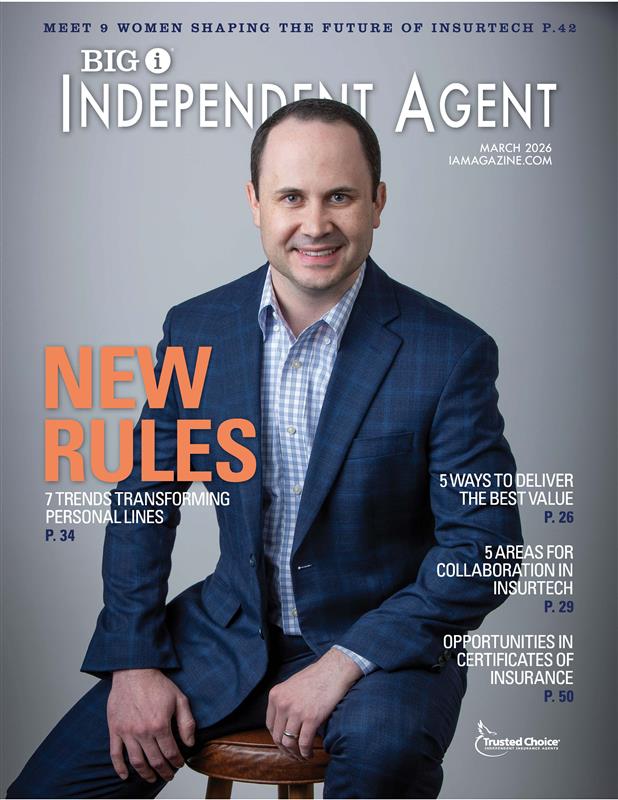
The March issue is out now!