Rounding Up: Overcoming the Service Team’s Objections About Account Rounding

By Jessica Orange and Bonnie Weise
Most agencies understand the benefits of cross-selling and account rounding. It increases revenue and builds trust with clients. However, implementing this strategy can be tough, particularly for teams that are concerned about taking on a process that feels at odds with their current roles or have apprehension about obtaining their property & casualty license, if not licensed today.
Service team members are typically more comfortable working within established boundaries and could be resistant to adding a task that feels more like sales than service.

Dan Fulwider Award for Community Service
Here are three common objections from service teams and how to not just overcome them, but get team buy-in and enthusiasm:
1) “This will damage the client relationship.” Service and other support teams tend to thrive on stability and structure, often fearing disruption to their traditional working style. They frequently have low risk tolerance and are empathetic to client interests, so it’s natural for them to raise concerns about something that feels counter to nurturing that relationship. Many service teams believe account rounding could leave clients with a negative impression or even risk losing them.
Solution: Communicate that the service team may be in the best position within a firm to identify opportunities to offer clients new coverage or increase their existing coverage limits. They’re the ones maintaining client relationships, uncovering individual needs and listening to concerns. These professionals have direct insights into the problems that account rounding can solve and can present solutions that meet those needs more seamlessly.
Also, ensure that the service teams understand this process isn’t an aggressive sell but a consultative risk-reduction approach. By adding account rounding to conversations, they can help clients find specialized policies for unique needs and educate them on the benefits of adding those policies and products.
For example, maybe they have a client who would benefit from adding additional workers compensation coverage. Service staff should rely on their proven communication style and persuasion skills to convey why the workers comp policy is a necessary safety net, helping the client mitigate any financial burdens. Often, proposing another solution enhances the client relationship by showing that you understand their needs and further positions yourself as a trusted adviser.
2) “I don’t have time.” For any professional, taking on a new, seemingly complex task will come with resistance. That feeling is particularly true of top performers, who might feel their current workload is already quite challenging and that adding something else would be unmanageable or cause setbacks to individual or firm goals.
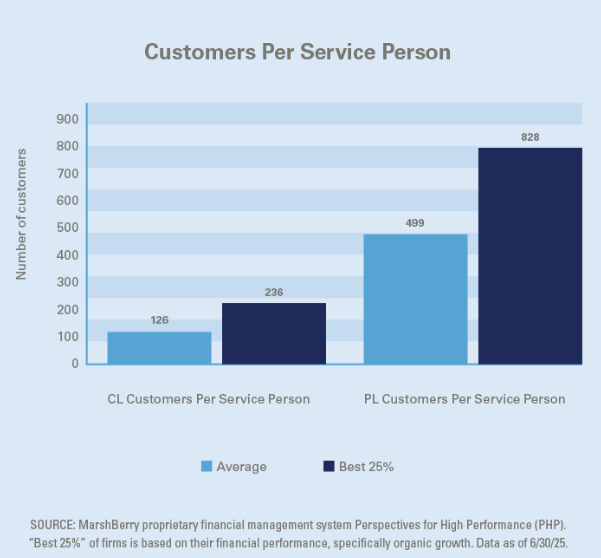
Solution: Before dismissing this concern, it’s important to examine the average book size of your service staff and how it compares to the rest of the industry. The chart shows that the average commercial lines service person serves about 126 customers, while employees in top firms serve closer to 236 customers on average. The difference is even more striking on the personal lines side, where staff in top firms serve twice as many customers as in average firms.
If analysis proves the service team is genuinely overloaded, look into virtual assistants or an outsourcing service that can take over time-consuming tasks. But if the numbers show their workload is lighter than that of service teams at similarly sized firms, that could signal a different problem. Figure out if the issue is something the firm needs to fix—such as a poorly designed process, technology problems or training limitations—or due to an individual performance problem like time management issues, knowledge gaps or even poor job fit.
3) “I don’t have the right skills.” Some service staff may see this process as hard selling, a skill that feels contradictory to their role of cultivating long-term relationships. They could also feel that this process is more akin to the producer role and worry that their lack of sales experience will prevent them from being successful.
Solution: The truth is that account rounding is a skill set much like what they already do today. Service staff tend to be empathetic, consultative and detail-oriented, and they’re able to uncover complex coverage solutions. These are all skills useful for account rounding.
More From IA Magazine



To help service teams more easily agree to an extra task, consider adding additional compensation or bonuses as they achieve growth goals. Beyond financial rewards, what else motivates them to perform? Is it recognition, advancement opportunities or schedule flexibility? All these perks can be offered as rewards as the business grows.
Since account rounding generates additional revenue and improves long-term retention, it benefits the business and its employees. Frequent, consistent communication and alignment in leadership are critical to driving success and trust in this endeavor.
Once service teams understand how account rounding actually strengthens client relationships, improves service and boosts retention renewal rates, the change in mindset and attitude can be significant.
Jessica Orange is senior consultant at MarshBerry and Bonnie Weise is senior growth advisory specialist at MarshBerry.
Agency Management Solutions
This month’s issue

The February issue is out now!