Why an Average of 225,000 Construction Jobs Per Month Is a Problem for Your Agency
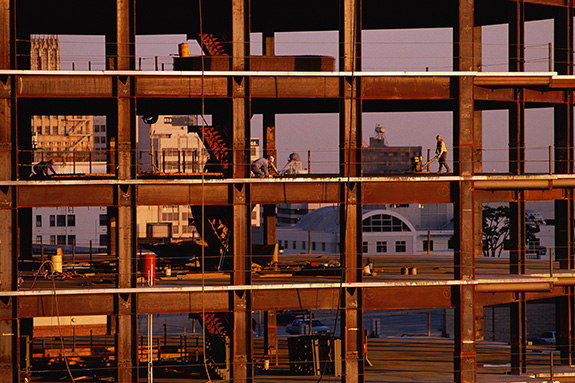
The hum of construction equipment is a constant in many cities and towns across America, which are in the midst of a building boom. From Los Angeles to Seattle, eastward to Detroit and New York, and throughout oil country, residential, commercial and industrial construction is in high gear.
If only there were enough skilled tradespeople to do the work. A labor skills shortage gives rise to risks that a specialized construction industry policy can help mitigate.
Employers are looking to fill an average of 225,000 construction jobs per month—marking the biggest employment supply and demand dislocation in the industry since 2007, according to the Bureau of Labor Statistics.
How bad is the situation? According to a recent survey for the Commercial Construction Index, compiled for USG Corporation and the U.S. Chamber of Commerce, 94% of contractors, construction managers, builders and trade contractors are having a “difficult” or “moderately difficult” time finding skilled workers.
One reason for the difficulty is the 2007-2008 construction contraction. “Out of work, many skilled tradespeople found employment elsewhere and continue on in those jobs,” says Gary Clevenger, vice president, risk control at CNA Insurance. “It’s a significant loss, since these individuals have journeymen licenses and on-the-job experience.”
And replacing these workers is challenging. “Jobs in construction tend to evoke unflattering images of dirty, dangerous and demeaning work, which is not the case at all,” Clevenger says. “The industry today is very automated, with people doing intricate work using high-tech machinery and equipment.”
The difficult employment situation is compelling many contractors to hire workers as framers, carpenters and general laborers who have very little experience. The lack of prior training among new workers puts pressure on site supervisors and foremen to don their tool belts to get the job done correctly.
“The combination of inexperienced construction workers, and middle-aged and older foremen taking on tasks they would normally supervise, creates an increased possibility of inferior craftsmanship, culminating in serious construction defects that arise after project completion,” says Rick Childs, vice president, underwriting for construction at CNA Insurance.
Due to the multiple contractors and subcontractors engaged in a typical building project, the cause of construction defects can be hard to identify, and civil litigation often ensues. Even though employers are protected by insurance policies absorbing most construction defects and completed operations liabilities, not all carriers understand the nuances of the construction industry.
Consequently, it’s incumbent upon agents and brokers to partner with a specialist insurance carrier that has broad underwriting expertise, deep claims knowledge, and superior insurance coverage terms and conditions. “A generalist insurer is unlikely to have such capabilities,” Clevenger says.
By contrast, CNA Insurance has a storehouse of risk-control resources, encompassing trade-specific risk specialists, certified safety professionals, on-site education, and training in the safe and proper use of tools and equipment. It has dedicated risk-control experts and a full suite of comprehensive insurance coverages tailored to the industry’s specific needs.
By partnering with CNA Insurance, independent agents and brokers can provide state-of-the-art risk-control services and specialized insurance coverages to contractors and subcontractors in their local areas at a time when this expertise is desperately needed—helping clients take advantage of the building boom in ways that reverberate for each party’s bottom line.

This month’s issue

The September issue is out now!