The Personal Touch: Meet the New Big ‘I’ Chairman
By: Jacquelyn Connelly
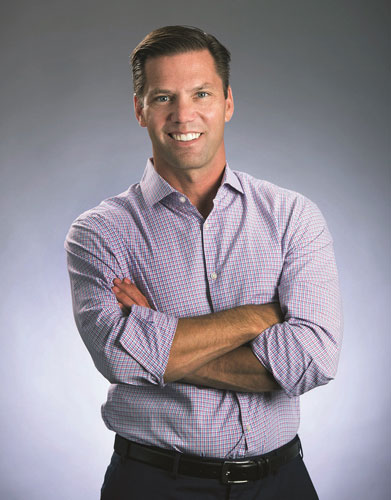 When new Big “I” Chairman Spencer Houldin and his brother Peter bought Ericson Insurance Advisors from their parents 10 years ago, the firm was a typical Main Street agency: a jack of all trades dabbling in life-health and benefits, with a book of about 60% standard personal lines and 40% commercial.
But shortly after taking the reins, the brothers attended a seminar at the Wharton School that changed their business lives forever. During the session, a professor explained that for any business to succeed, it must focus on one of three things: the lowest price, the most innovative developments or the most intimate customer experience.
“The point he was making is if you’re stuck in the middle, then you’re just like everyone else,” recalls Houldin, 46, who is now president of Ericson. “We saw that the commodity buyer was going to go to the internet, so we decided to focus on customer intimacy. We wanted to retool our firm into one where clients value us for our advice.”
The agency started going after high net-worth individuals, and a decade later, Ericson is 90% personal lines. “We have 20 less clients today than we had 10 years ago, and our written premium is five times as much,” Houldin says. IA spoke with Houldin about his lifelong insurance career, working with family and his plans to reinforce the value of Big “I” membership during his term as the association’s next chairman.
IA: Tell us a little about your personal background.
Houldin: I was born and raised in Washington, Connecticut, a town of about 2,500 people in the foothills of the Berkshire Mountains. My father and mother owned the agency—Dad was the main producer and Mom took care of the books. When I graduated college in 1991, I entered the business. Four years later, my younger brother joined me. Today, he and I are 50/50 owners. We bought the stock 10 years ago and Dad and Mom walked out the door—they were ready to pass the reins and fully retire. They’re having fun in retirement.
So I really have been in insurance since the day I was born, because the only time my parents had to talk about the business outside the business was at the dinner table. We grew up talking about Ericson. My father bought the firm from Mr. Arlo Ericson, and we’ve kept the name all these years. It’s been in the family for 40 years.
Why insurance?
I absolutely did not know this was what I wanted to do. I had taken the LSATs, so I wanted to go to law school. I was a government and law major in college, and I decided senior year around Christmas break that I was really tired of school. So I went to my father and I said, “What do you do again?” Next thing you know, I’m in insurance. It’s been a wonderful experience. It’s given me a great opportunity to help people and it’s given me great flexibility in life. I work really hard, but I love every minute of it.
How did you get involved with the Big “I”?
I had a very successful college career, so before I started working for the agency, my parents gave me the summer off. They said, “Start Sept. 1—take a break from life, because you’ve really been working hard.” In August, before I actually started, I went to the Connecticut Young Agents Big “I” Golf Tournament. Somebody from the association said, “We should get you on the Young Agents Committee [YAC].”
Then, I had that normal procession where I was on the YAC, became the young agents chair, was on the state executive committee, became the state president, became the national director, became the government affairs committee chair, ran for the national executive committee and here we are. So it has literally been a 25-year career with the Big “I” since the day I started in the industry.
We take the Big “I” for granted, but if you took the Big “I” away from the industry and pretended it never existed, we would look very different. When you think about our successes over 120 years—all the things we’ve done, all the things we’ve protected—the Big “I” has had an amazing influence on all of us. And I think the future is just as bright. So I haven’t known insurance life without the Big “I,” but I’m glad not to have known life without the Big “I.” This association has done so much for me that I probably don’t even realize.
Tips on running a family business?
It’s really quite simple: You have to have tolerance with each other. You can’t let anything get in the way of your relationships, especially your family relationships. My brother and I are lucky in that we both work really hard. I think where family businesses fail is when one person feels as though they’re working harder than the other person, and then there’s the jealousy factor. So you have to be considerate to your partner and your other family members, and you just have to make sure you don’t let their actions bother you, because it’ll sink.
We have learned how to get along. We’ve owned the business for 10 years together, but we’ve worked together for 21, and there are no issues. But my brother and I are very lucky—we’re very different people. He loves to be inside with a normal routine and I like to be outside the office as a rainmaker, so we complement each other perfectly. If you have two people who want to be on the inside, you’re in trouble.
What are the most important issues facing the independent agent system today?
I think it’s twofold: it’s mergers & acquisitions, and it’s perpetuation. The industry itself is solid. The opportunities we have as independent agents are stronger today than they were 10 years ago. Some of the strengths the captive agents or the internet bring—technology and being able to answer questions quickly and offer services on a more 24/7 basis—we’re starting to gain on those in a significant way. Once we couple our local advisement strength with the ability to service on a more consistent basis, we’re going to win out. The independent agency system is going to succeed.
But as an association, we need to continue to bring that value to our members. People don’t need us for the same thing they needed us for 30 years ago, such as continuing education or some of the products they can get elsewhere. The independent agent needs to find a way to stay independent, and we need to find new talent to enter our businesses.
What are your goals for your term as chairman?
No. 1 is increasing membership. There are a lot of independent agencies out there that don’t belong to our association. I think we need to stop worrying about losing members from M&As and start thinking about how we can attract new members. In order to do that, we need to be able to show them the value proposition. Why should they belong? One of my goals is to do a better job telling our story. We do a lot of great things that even our existing members don’t know about, and our prospects definitely don’t know about. So I am working with the executive committee and senior and staff leadership on membership recruitment and how we can help state associations grow their membership. As soon as we do that, it increases our dues revenue, but it also gives us new people to sell our products to.
No. 2 is a focus on the macro sense of technology in the independent agency. I’m going to rely on groups like the Agents Council for Technology and -TrustedChoice.com to help me there. We are all small businesses—we don’t have huge budgets for making sure we have the right safeguards on our servers in our closets. Let’s get to the point where we’re pushing the ball forward on using technology to deliver an amazing customer experience. We need to find a way to ensure that when somebody gets that renewal form for their membership, they say, “Not only do I want to pay this bill, but I have to pay this bill, because I cannot afford to not be a member of the Big ‘I.’”
Jacquelyn Connelly is IA senior editor. Photography by Alan Grant.
Notes on ResilienceWhat’s the biggest challenge of running an independent agency today? Houldin says it’s the “psychology of the human mind.” “I didn’t go to school and learn HR,” he explains. “I didn’t learn how to resolve conflict among other individuals. The HR part of the business is very, very tough. After 25 years, I have improved, but I still can’t figure out how to work that dimension of it. That’s the biggest challenge—running a business and learning all the different aspects of running a business.” But the Houldin brothers have found a way to make it work, thanks in large part to “a lot of hard work” and a commitment to the high net-worth niche, Houldin says. “Once you decide to set your direction for your agency, you have to commit to it,” Houldin cautions. “And that can be very difficult. You may have an old family friend who wants you to help him, but if it’s outside of what you do, you have to have the guts to say no. That was the toughest thing—transforming and getting all the employees to understand the customer intimacy direction.” No small feat—but no problem for two self-proclaimed work-aholics. “If you work hard, good things will happen,” Houldin shrugs. “It’s just the way it is. But you can’t show up at 9 and leave at 5. You have to be fully immersed and fully committed to being successful, and you will be.” —J.C. |
This month’s issue
The March issue is out now!