Branding Research and Bottom Line Responsibility
By: Jack Gordon
New products are the life-blood of most companies’ futures. And, advertising, because of its ability to communicate a consistent brand message over time, is the key brand-building marketing element. So why do 70% to 90% of new products fail, and at least half of all advertising campaigns prove unsuccessful in helping to build business?
Internal company discussions often revolve around whether or not branding and marketing initiatives should be tested, and how. Ultimately, the decision to not test is often based upon an ongoing trust of the company’s creative, a confidence in management’s ability to “make the right decision” or simply not wanting to spend the money. As the statistics of failure demonstrate, most of us don’t have the capability to constantly outthink today’s consumers, who have become increasingly demanding in their evaluation of new products and advertising claims.
Companies are willing to spend millions on new products, advertising and even promotions. So, doesn’t it make sense to submit these to research in order to be able to substantiate whether consumers need or want them? The question is not simply one of, “what is the cost of not testing?” But, “what is the cost of not testing correctly?”
Companies that consistently execute new products have a research system in place that ultimately offers them the optimal chance for success. Survival does not rest upon an assumption that the correct decision is being made; instead research is in place to ensure that new products and marketing efforts are given every possible chance to succeed.
Both qualitative and quantitative research has its place, but they are not interchangeable. Qualitative should be used to help find direction. It is perfect for helping companies discover valuable insights or directions for new products or advertising. However, quantitative research is the correct evaluative tool for measuring the full potential of concepts, products, ads and other marketing materials.
Unfortunately, we often find that commercials have been tested qualitatively in order to choose one campaign over another, resulting in a final decision to move forward a particular campaign based on the opinions of 30 to 40 people in a typical focus group. Companies justify this research as they feel they can obtain answers faster and cheaper. Having used this fast and non-predictive research method, a company will then spend additional funds on media.
Quantitative screening research provides the ability to test multiple commercials among a large, representative sample, gaining normative ratings, communication delivery of benefits and features, emotional appeal and the ability to get a forced choice. At the same time, companies can receive developmental help if they want it. Timing for quantitative research adds about a week on to the process, if the right research methodology is chosen.
Everyone marvels at the success some companies have with new products. This success is likely not accidental, but usually the product of a sound new product and marketing process. This level of success is available to everyone, if they take time to set up a formalized process for quantifying their marketing initiatives.
Jack Gordon is the CEO of AcuPOLL Research Inc., a global research agency that provides companies with business recommendations based on analysis of customized data.
Carrier Connection: Ohio Mutual Insurance
For Ohio Mutual Insurance, the first step to successful branding was taking a hard look at the company’s values and how it was perceived by independent agents.
According to Jim Kennedy, president and CEO of the Ohio Mutual Insurance Group in Bucyrus, Ohio, his company partnered with MBA students and faculty at a local college to examine the message Ohio Mutual was sending to its agents and customers. After several focus group sessions comprised of company partners, associates and agents, Ohio Mutual chose a three word catchphrase that captures its character:“passionate, innovative, partnerships.”
“At one time our brand was more product oriented, but now it’s more relationship focused,” says Kennedy. “We wanted to find something that would resonate with agents and would give us a chance to have more dialogue with them.”
In the end, Kennedy says Ohio Mutual’s branding experience was about validating the company’s image in the eyes of its agents.
“If you don’t know who you are and what you’re trying to accomplish, branding will be difficult,” he says. “Branding work allowed us to validate that what we thought we were is also valued by agents.”
Ohio Mutual is in the process of working its new brand into company materials and continues to build its relationship with agents through participation in Trusted Choice®. A co-branded Web site and a presence in multiple states has helped Ohio Mutual spread the Trusted Choice® name and connect with agents it might not have otherwise done business with.
“Agents are our partners. We care about their success and they care about ours, and Trusted Choice® gives us referential perspective to agents who may not otherwise know us,” says Kennedy.
—Veronica DeVore
Internal company discussions often revolve around whether or not branding and marketing initiatives should be tested, and how. Ultimately, the decision to not test is often based upon an ongoing trust of the company’s creative, a confidence in management’s ability to “make the right decision” or simply not wanting to spend the money. As the statistics of failure demonstrate, most of us don’t have the capability to constantly outthink today’s consumers, who have become increasingly demanding in their evaluation of new products and advertising claims.
Companies are willing to spend millions on new products, advertising and even promotions. So, doesn’t it make sense to submit these to research in order to be able to substantiate whether consumers need or want them? The question is not simply one of, “what is the cost of not testing?” But, “what is the cost of not testing correctly?”
Companies that consistently execute new products have a research system in place that ultimately offers them the optimal chance for success. Survival does not rest upon an assumption that the correct decision is being made; instead research is in place to ensure that new products and marketing efforts are given every possible chance to succeed.
Both qualitative and quantitative research has its place, but they are not interchangeable. Qualitative should be used to help find direction. It is perfect for helping companies discover valuable insights or directions for new products or advertising. However, quantitative research is the correct evaluative tool for measuring the full potential of concepts, products, ads and other marketing materials.
Unfortunately, we often find that commercials have been tested qualitatively in order to choose one campaign over another, resulting in a final decision to move forward a particular campaign based on the opinions of 30 to 40 people in a typical focus group. Companies justify this research as they feel they can obtain answers faster and cheaper. Having used this fast and non-predictive research method, a company will then spend additional funds on media.
Quantitative screening research provides the ability to test multiple commercials among a large, representative sample, gaining normative ratings, communication delivery of benefits and features, emotional appeal and the ability to get a forced choice. At the same time, companies can receive developmental help if they want it. Timing for quantitative research adds about a week on to the process, if the right research methodology is chosen.
Everyone marvels at the success some companies have with new products. This success is likely not accidental, but usually the product of a sound new product and marketing process. This level of success is available to everyone, if they take time to set up a formalized process for quantifying their marketing initiatives.
Jack Gordon is the CEO of AcuPOLL Research Inc., a global research agency that provides companies with business recommendations based on analysis of customized data.
Carrier Connection: Ohio Mutual Insurance
For Ohio Mutual Insurance, the first step to successful branding was taking a hard look at the company’s values and how it was perceived by independent agents.
According to Jim Kennedy, president and CEO of the Ohio Mutual Insurance Group in Bucyrus, Ohio, his company partnered with MBA students and faculty at a local college to examine the message Ohio Mutual was sending to its agents and customers. After several focus group sessions comprised of company partners, associates and agents, Ohio Mutual chose a three word catchphrase that captures its character:“passionate, innovative, partnerships.”
“At one time our brand was more product oriented, but now it’s more relationship focused,” says Kennedy. “We wanted to find something that would resonate with agents and would give us a chance to have more dialogue with them.”
In the end, Kennedy says Ohio Mutual’s branding experience was about validating the company’s image in the eyes of its agents.
“If you don’t know who you are and what you’re trying to accomplish, branding will be difficult,” he says. “Branding work allowed us to validate that what we thought we were is also valued by agents.”
Ohio Mutual is in the process of working its new brand into company materials and continues to build its relationship with agents through participation in Trusted Choice®. A co-branded Web site and a presence in multiple states has helped Ohio Mutual spread the Trusted Choice® name and connect with agents it might not have otherwise done business with.
“Agents are our partners. We care about their success and they care about ours, and Trusted Choice® gives us referential perspective to agents who may not otherwise know us,” says Kennedy.
—Veronica DeVore
This month’s issue
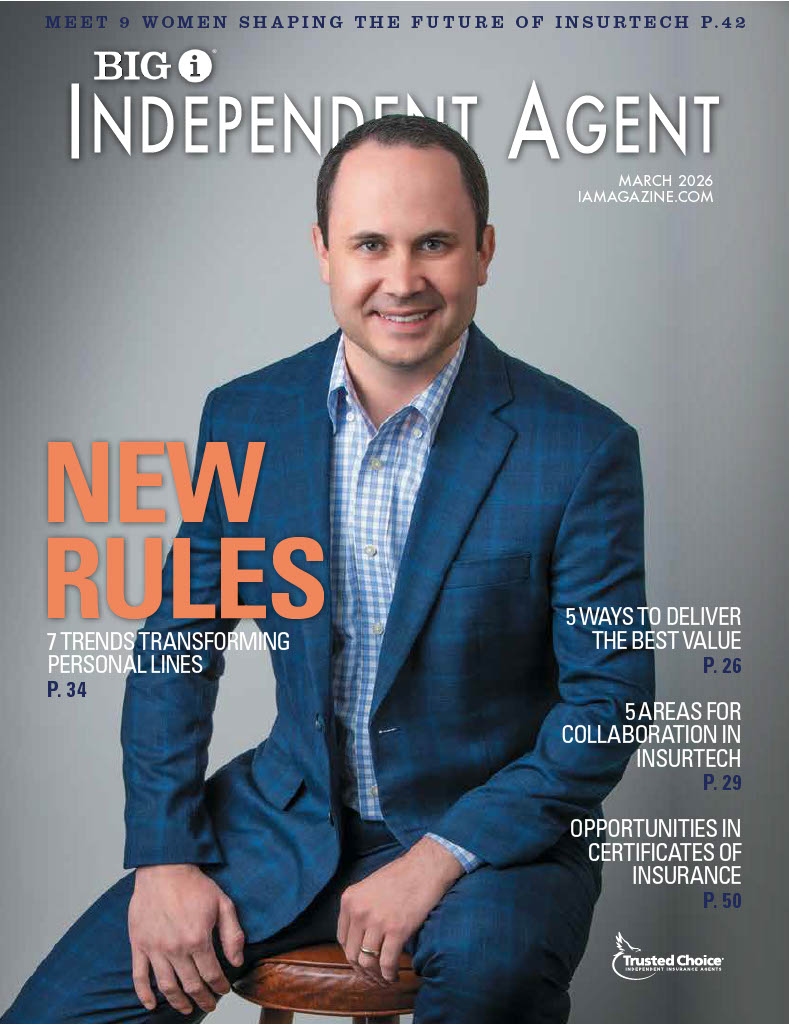
The March issue is out now!