The Value of a Value Proposition
By: Drew Stevens
I work with many business owners and selling professionals. When I ask them what they do they immediately rush into their title. Each states, “I am the president of a bank” or “I am a consultant.” If I were a client and heard this, I’d immediately state, “So what?”
Today, professionals refrain from their titles and occupations in the service business and speak as if replying to the “So what?” The method for doing this is known as value proposition. Simply put, a value proposition is a pithy statement that promotes the business to clients using outcome and results. This brief statement denotes the benefits a client receives from working with you. It is outcome based and focuses all attention on client outcomes, not processes or methods.
The proliferation of both the Internet and small business has created a conundrum of noise and activity around clients. That said it is vital for your services to be heard. Organizations today require focus on two complicated issues: productivity and profitability. Your mission is to create a succinct message that addresses these concerns to the decision maker.
Be mindful, this is not an elevator speech. The value proposition succinctly addresses the concern. The statement also helps with branding. A perfect example is FedEx—absolutely guaranteed to be there overnight. Not only is this one of the most powerful value propositions in the world, but one of the best brands.
So how do you develop a value proposition? It should contain no more than 10 to 15 words and feature as many adjectives as possible. Value propositions also have these characteristics: focus on what the buyer gets; focus on results that use colorful words to gain attention and general so it appeals to a wide audience.
How can an organization or individual develop a value proposition? The concept for developing a statement is not difficult to achieve, yet it takes patience. It’s vital to look at the organization from a customer or competitive view. Don’t expect to obtain a statement overnight, yet don’t belabor it either. Too many organizations spend countless hours on mission, vision and values yet the organizational culture does not exemplify the creed or shamefully does not understand it. However, if you want better results for your sales and marketing efforts, it is best to begin with asking questions focused on client value and return on investment to the client. If you cannot find the answers, the best source is your clients! Testimonials and case studies are great examples of value. Take their statements and simply develop them into benefit-based sentences.
It is imperative to understand that no magic formula exists for the creation of a value proposition. Further, it is an often overlooked and underutilized tool. And, organizations typically confuse mission and vision statements with benefit-based phrases. However, when researched, reviewed and required, these thought-provoking statements might help your organization to break away from the pack. Drafting an articulate message might be the split second differentiator between a cursory review of your competitor’s brochure or phone call and yours. Craft a new message, speak of value and results and watch your brand grow.
Drew Stevens (www.gettingtothefinishline.com) is a sales strategist and author of seven books including, Split Second Selling, Split Second Customer Service and Little Book of Hope.
Carrier Connection: Austin Mutual Insurance
Any brand change is a challenging process requiring dedication and a clear set of goals. Austin Mutual Insurance recently overhauled not only its logo, but its entire company culture to reflect pride, ownership and a deep connection to independent agencies.
“Our company headquarters just moved into the first building we have ever owned, a real symbol of pride for the employees,” says Bob Long, senior vice president of marketing at Austin Mutual. “We were looking for a major culture change within the company, which is probably one of the hardest things to change.”
Independent agencies play a larger than-life role in that change: the art work in Austin Mutual’s new building features giant photos of the company’s independent agency partners.
“We wanted our employees to see every day who plays a major role in our success as a company,” Long says. “Since independent agents are our sole means of distribution, the photos remind people who our business partners are.”
According to Long, several agencies chose to be pictured with the Trusted Choice® logo in the background. Since joining the Trusted Choice® brand about a year ago, Austin Mutual has involved all of its employees in “living the brand.”
“It’s a constant struggle to differentiate your company, and that’s really how Trusted Choice® entered into our long-range plans,” says Long. “If we’ve learned anything from the process we’ve recently gone through with the development of Trusted Choice® and a new branding strategy, it’s to take time to really think about the message you’re trying to send.”
—Veronica DeVore
Today, professionals refrain from their titles and occupations in the service business and speak as if replying to the “So what?” The method for doing this is known as value proposition. Simply put, a value proposition is a pithy statement that promotes the business to clients using outcome and results. This brief statement denotes the benefits a client receives from working with you. It is outcome based and focuses all attention on client outcomes, not processes or methods.
The proliferation of both the Internet and small business has created a conundrum of noise and activity around clients. That said it is vital for your services to be heard. Organizations today require focus on two complicated issues: productivity and profitability. Your mission is to create a succinct message that addresses these concerns to the decision maker.
Be mindful, this is not an elevator speech. The value proposition succinctly addresses the concern. The statement also helps with branding. A perfect example is FedEx—absolutely guaranteed to be there overnight. Not only is this one of the most powerful value propositions in the world, but one of the best brands.
So how do you develop a value proposition? It should contain no more than 10 to 15 words and feature as many adjectives as possible. Value propositions also have these characteristics: focus on what the buyer gets; focus on results that use colorful words to gain attention and general so it appeals to a wide audience.
How can an organization or individual develop a value proposition? The concept for developing a statement is not difficult to achieve, yet it takes patience. It’s vital to look at the organization from a customer or competitive view. Don’t expect to obtain a statement overnight, yet don’t belabor it either. Too many organizations spend countless hours on mission, vision and values yet the organizational culture does not exemplify the creed or shamefully does not understand it. However, if you want better results for your sales and marketing efforts, it is best to begin with asking questions focused on client value and return on investment to the client. If you cannot find the answers, the best source is your clients! Testimonials and case studies are great examples of value. Take their statements and simply develop them into benefit-based sentences.
It is imperative to understand that no magic formula exists for the creation of a value proposition. Further, it is an often overlooked and underutilized tool. And, organizations typically confuse mission and vision statements with benefit-based phrases. However, when researched, reviewed and required, these thought-provoking statements might help your organization to break away from the pack. Drafting an articulate message might be the split second differentiator between a cursory review of your competitor’s brochure or phone call and yours. Craft a new message, speak of value and results and watch your brand grow.
Drew Stevens (www.gettingtothefinishline.com) is a sales strategist and author of seven books including, Split Second Selling, Split Second Customer Service and Little Book of Hope.
Carrier Connection: Austin Mutual Insurance
Any brand change is a challenging process requiring dedication and a clear set of goals. Austin Mutual Insurance recently overhauled not only its logo, but its entire company culture to reflect pride, ownership and a deep connection to independent agencies.
“Our company headquarters just moved into the first building we have ever owned, a real symbol of pride for the employees,” says Bob Long, senior vice president of marketing at Austin Mutual. “We were looking for a major culture change within the company, which is probably one of the hardest things to change.”
Independent agencies play a larger than-life role in that change: the art work in Austin Mutual’s new building features giant photos of the company’s independent agency partners.
“We wanted our employees to see every day who plays a major role in our success as a company,” Long says. “Since independent agents are our sole means of distribution, the photos remind people who our business partners are.”
According to Long, several agencies chose to be pictured with the Trusted Choice® logo in the background. Since joining the Trusted Choice® brand about a year ago, Austin Mutual has involved all of its employees in “living the brand.”
“It’s a constant struggle to differentiate your company, and that’s really how Trusted Choice® entered into our long-range plans,” says Long. “If we’ve learned anything from the process we’ve recently gone through with the development of Trusted Choice® and a new branding strategy, it’s to take time to really think about the message you’re trying to send.”
—Veronica DeVore
This month’s issue
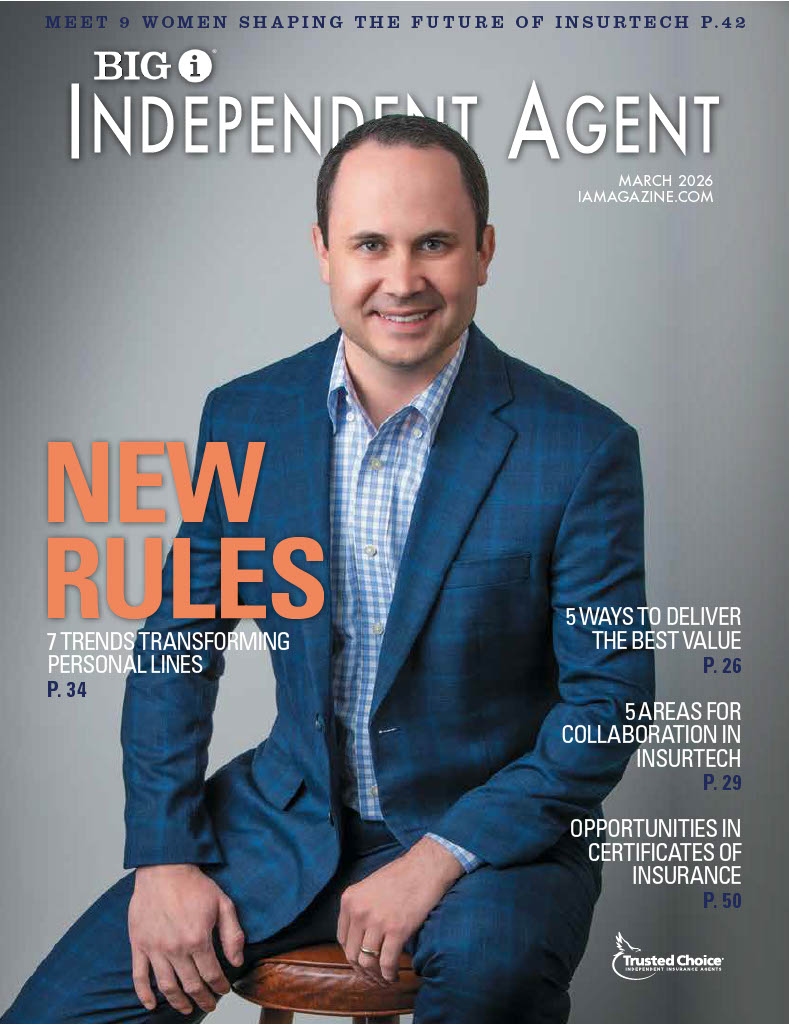
The March issue is out now!