Insuring Non-Auto Vehicles
By: Bill Wilson
So, the question is, “where’s the coverage?” Determining HO coverage is not necessarily an easy process. Some vehicles are covered or excluded in certain circumstances based on type or body style (golf carts, for example), yet the same vehicle can be covered or excluded by usage (service, for example).
Another key factor in some situations is whether the vehicle is owned or not. However, this is not universally relevant to all miscellaneous personal vehicles. In certain instances, the coverage form distinguishes owned versus non-owned vehicles. In others, there is no distinction made between owned or non-owned.
To read a more complete coverage analysis of various types of motor vehicles, click here.
Insuring Commonly-Owned Entities
The Virtual University’s “Ask an Expert” service is periodically asked about the best way to insure two or more entities or locations under common ownership. Is it better to put them all under one, theoretically more manageable, CGL policy or should each have its own policy?
One advantage of a single policy is manageability for the agent, carrier and insured. There’s only one set of policy forms and endorsements to contend with, one renewal date and so forth. When the number of entities goes beyond just a few, this becomes an increasingly important consideration.
An obvious downside to the “one policy fits all” approach is adequacy of limits and the possibility that the aggregate may be depleted quickly. Where a single policy is indicated, it is essential that high limits be purchased and that arrangements are made from a coverage and premium standpoint for reinstating aggregate limits. If an umbrella is used, a drop-down provision is advisable.
Another problem may arise when the entities are significantly different in exposures and operations. One may require special endorsements the other doesn’t, which could result in overpayment of premium unless designated premises limitations are endorsed to restrict coverage and premium promulgation to the entity that needs the coverage.
For further considerations outlined in more than a dozen faculty and subscriber comments, click here.
Something Stinks
An insured calls your office to report a claim involving a toilet, sink or washing machine that overflowed and caused damage to carpeting, flooring, woodwork or other property. The adjuster determines the overflow resulted from a clogged drain and denies the claim, citing the homeowners “water damage” exclusion.
This type of claim has been debated for years and involves balancing the covered peril of accidental discharge from a plumbing system with the exclusion for the backup of sewers or drains. The Virtual University faculty debated this issue and couldn’t fully agree!
If you’d like to examine the VU faculty’s rantings, along with some court case citations and other expert opinion, click here.
Bill Wilson (bill.wilson@iiaba.net) is Big “I” director of the Virtual University, an online learning center for agents and brokers.
This month’s issue
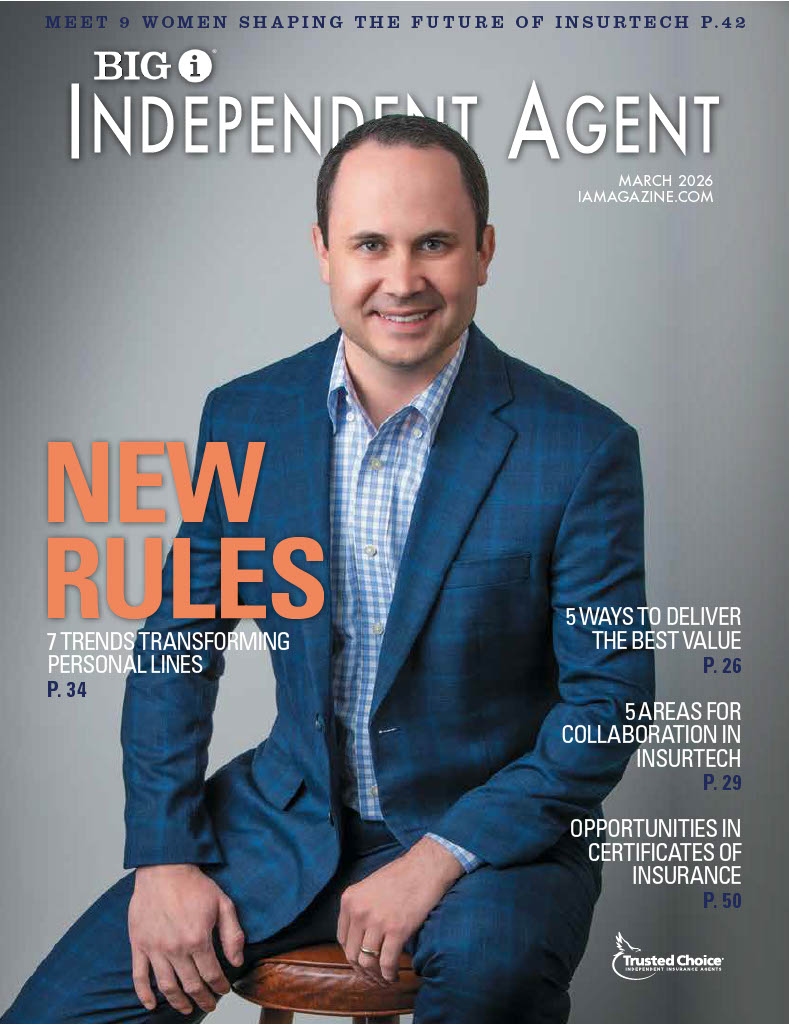
The March issue is out now!