Framing the Producer Compensation Debate
By: Alex Soto
The For many agencies, it’s the difference between red ink and black ink on the balance sheet. Producer compensation will be the most important issue during my presidency. I did a calculation two years ago when New York Attorney General Eliot Spitzer announced his first suit that puts it into perspective. Fully 50% of our members rely on incentive compensation and contingent commissions to move the needle to profitability for the year. Producer compensation is a difficult topic, and it cuts to the heart of our industry. There is no issue that will have a greater impact on the future of the independent agency system, and that is why we have chosen to include a comprehensive special section on producer compensation in this edition of Independent Agent magazine.
At some point, every industry faces a critical juncture that will affect its stability, health and business practices going forward. We have reached that fork in the road. We’re taking this issue seriously, and recognize it ranks among the most important challenges we’ve ever faced as an association. Some have even put it on par with the ownership of expirations issue. We appreciate that the outcome of this debate—whether it takes place in the courts, state regulators’ offices or in carrier boardrooms—will affect each and every member agency of the Big “I.”
Our association continues to stand behind its initial position which we released in October 2004: incentive compensation and contingent commissions are a legal, effective means of compensation. We believe that illegal activities should be pursued and prosecuted. But, we do not believe that illegal activities should be confused with sound free-market sales practices, including the use of incentive compensation. Like virtually all other businesses distributing products through a sales force, the insurance industry has developed effective compensation practices to reward sales excellence. This includes the ability of insurers to choose how to pay for strong sales performance, just as is done in virtually all sales environments.
We have seen significant industry players change their position on the issue of incentive compensation during the last two years. ‘’Our clients don’t like contingency agreements…We’ve heard them loud and clear,’’ Willis Chairman and CEO Joe Plumeri said during an analyst conference call on Oct. 21, 2004. ‘’They want contingencies to end, and we intend to respond to that. It’s over.” Further commenting on the decision in the foreign press, Plumeri told The Irish Times in November 2004 that, “Lots of people get religion in battle. But there is a lot of background to what Willis did. What I did by abolishing contingents is very consistent with what I have done since becoming chairman of this company.” However, earlier this month, Willis agreed to amend its agreements with New York’s attorney general and insurance commissioner to allow brokers to accept incentive compensation when they work exclusively as a managing general agent for the carrier. Other brokers, including Aon and Marsh & McLennan have done the same.
While we might respectfully disagree with the stance of some industry players, the Big “I” has been unwavering in its position. We’ve taken every opportunity to reinforce our position, both privately and publicly, with regulators, legislators and, most importantly, carriers. (For more on the association’s comprehensive approach in addressing this issue, see p. 96). Some carriers involved in legal action surrounding bid-rigging, steering or other charges may choose to settle the suits, and not necessarily because they agree with the charges. Instead, they may want to spend their company’s time and resources on more economically productive activities like developing new products, rather than looking back at past alleged misconduct. That said, we applaud Liberty Mutual’s decision to fight the charges and we will do whatever we can to support any company’s efforts to retain its right to choose how to compensate its sales force.
The Big “I” will continue to work to protect the independent agency system no matter what the topic, and I look forward to serving as your president this year. No one can predict exactly what will happen with producer compensation in the future—not even the CEOs we interview on p. 46. But we’re hopeful that Travelers CEO Jay Fishman’s comment—“Not paying contingent commission is not equivalent to reduced compensation”—turns out to be true.
Alex Soto
President
This month’s issue
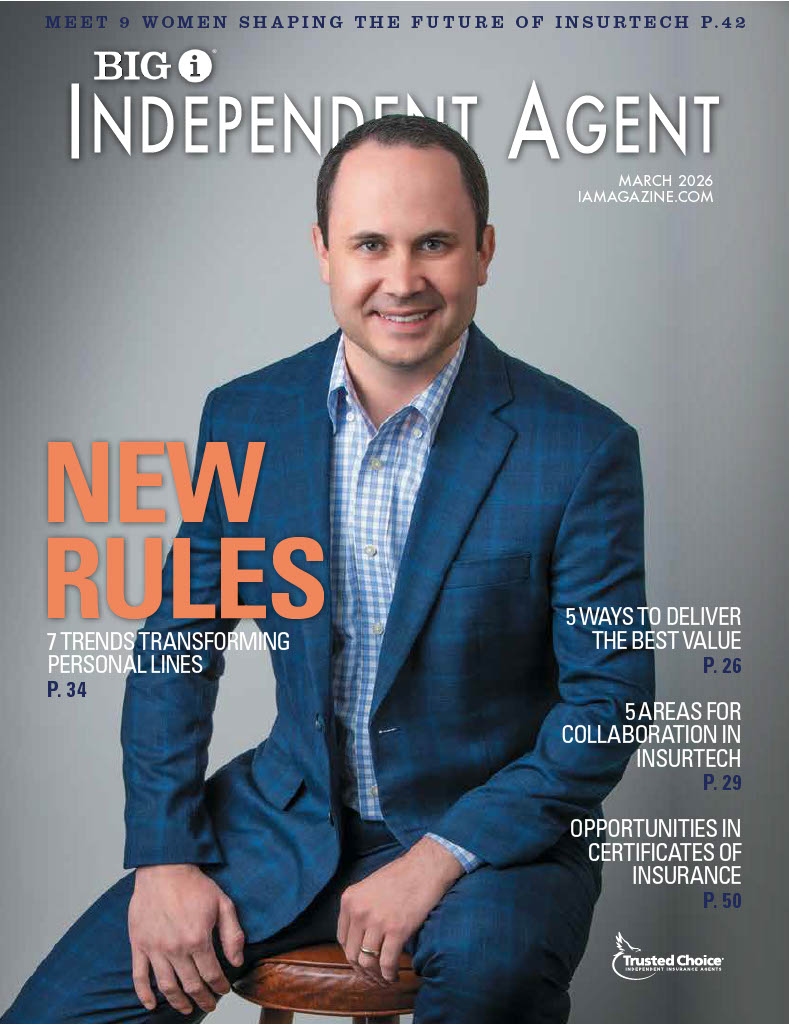
The March issue is out now!