Before the Next Big One
By: Bob Rusbuldt
You would think after the record number of hurricanes in the last several years (Wilma, Rita, Jeanne, Ivan)—along with the biggest natural disaster in U.S. history, Hurricane Katrina—that our industry and the federal government would hastily move to implement some rational risk management policies. You would think it would want to set up a private-public partnership to ensure homeowners insurance is available for American homeowners.
However, instead of a unified call for reform, there has been a mixed bag of responses from the industry, legislators and regulators. We have those saying the status quo is acceptable (granted, most of these people are in areas not prone to natural disasters). Some say they support a federal backstop for terrorism insurance but oppose it for homeowners insurance. Others have no opinion. And the federal government presently is saying that ad hoc disaster assistance—a.k.a. taxpayer bailouts—is the preferable way to handle the aftermath of catastrophic events.
Future natural disasters’ impact on our economy and industry is clear. Seventy percent of the current U.S. population lives within 50 miles of a coastline. Cities like Miami, Jacksonville, Tampa, Houston, New Orleans, New York City, Boston, San Diego, Los Angeles, San Francisco, Seattle and many others fit this description. How will the insurance industry and our government deal with these homeowners in the future?
For more than 15 years, the Big “I” has supported proposals calling for a federal reinsurance backstop for homeowners insurance, allowing either individual companies or state CAT funds to tap the backstop. We were part of a Homeowners Insurance Coalition that included a number of insurance companies, as well as other business groups outside of the insurance industry. Currently, we support H.R. 846, introduced by Congresswoman Ginny Brown-Waite (R-Fla). However, some oppose the bill as an industry bailout, or a competitive advantage to large national writers of homeowners insurance. We will support a tax-free reserving system similar to the one in Europe if it results in more carriers writing homeowners insurance. We support enhanced and strongly enforced building codes, and we support rate freedom. In reality, the Big “I” will support any reasonable proposal that will provide more homeowners markets in areas that need them.
Natural disaster reform proposals have not moved in Congress for a number of reasons. First, there is no consensus in our industry on how to handle the issue. Next, there is opposition to more federal or government intrusion in the insurance marketplace. Finally, there is the belief that a reform proposal would primarily benefit the large national homeowners companies. So, if we face this entrenched opposition to reform, what’s the alternative? The status quo? Eventually, a large portion of the U.S. population will be in dire straights and need homeowners coverage in states all around the nation, whether it is Missouri on the New Madrid fault line, New Jersey, California or North Carolina.
We are making progress on another important aspect of natural disasters: addressing the claims handling process. Big “I” senior staff, senior volunteer leadership and state representatives from Louisiana and Mississippi recently met with representatives from the American Insurance Association and the Property Casualty Insurers Association of America to discuss the industry’s claims handling response for Hurricane Katrina and other 2005 storms. The Big “I” conducted a survey of agents in the affected areas in order to provide feedback to carriers on the claims process. The goal of the meeting was to provide recommendations from Big “I” agents in order to improve claims performance for future natural disasters. Some of the agent recommendations to improve the claims process include: agent claim draft authority for smaller catastrophe claims, allowing adjuster authority to settle smaller claims at inspection and having carriers contract with catastrophic claims services with predetermined capacity and service standards. Meeting attendees felt the survey and subsequent discussions were worthwhile and there was a commitment to continue a dialogue as we work toward improvement.
Protecting against natural disasters and dealing with their aftermaths is an issue that will not be going away any time soon. In fact, it will get bigger and become more important to agents, carriers, federal and state governments and, of course, our customers. The time to act is now, before the next series of “big ones.” We don’t need to learn any more lessons. We know them all too well.
Bob Rusbuldt (bob.rusbuldt@iiaba.net) is CEO of the Big “I.”
This month’s issue
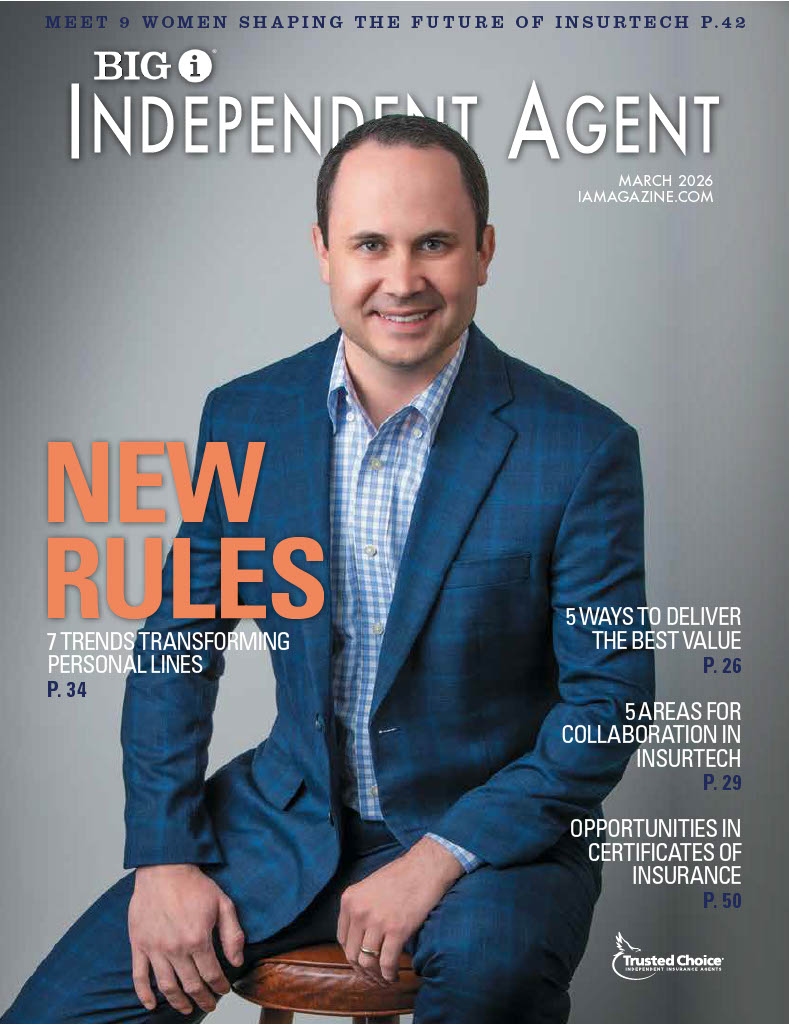
The March issue is out now!